“From Israel. Now”
April – August 2024, Congregation Mishkan Or Museum, Beachwood, OH
Etti Abergel, Max Epstein, Linor Goralik, Itzik Rennert, Osi Wald
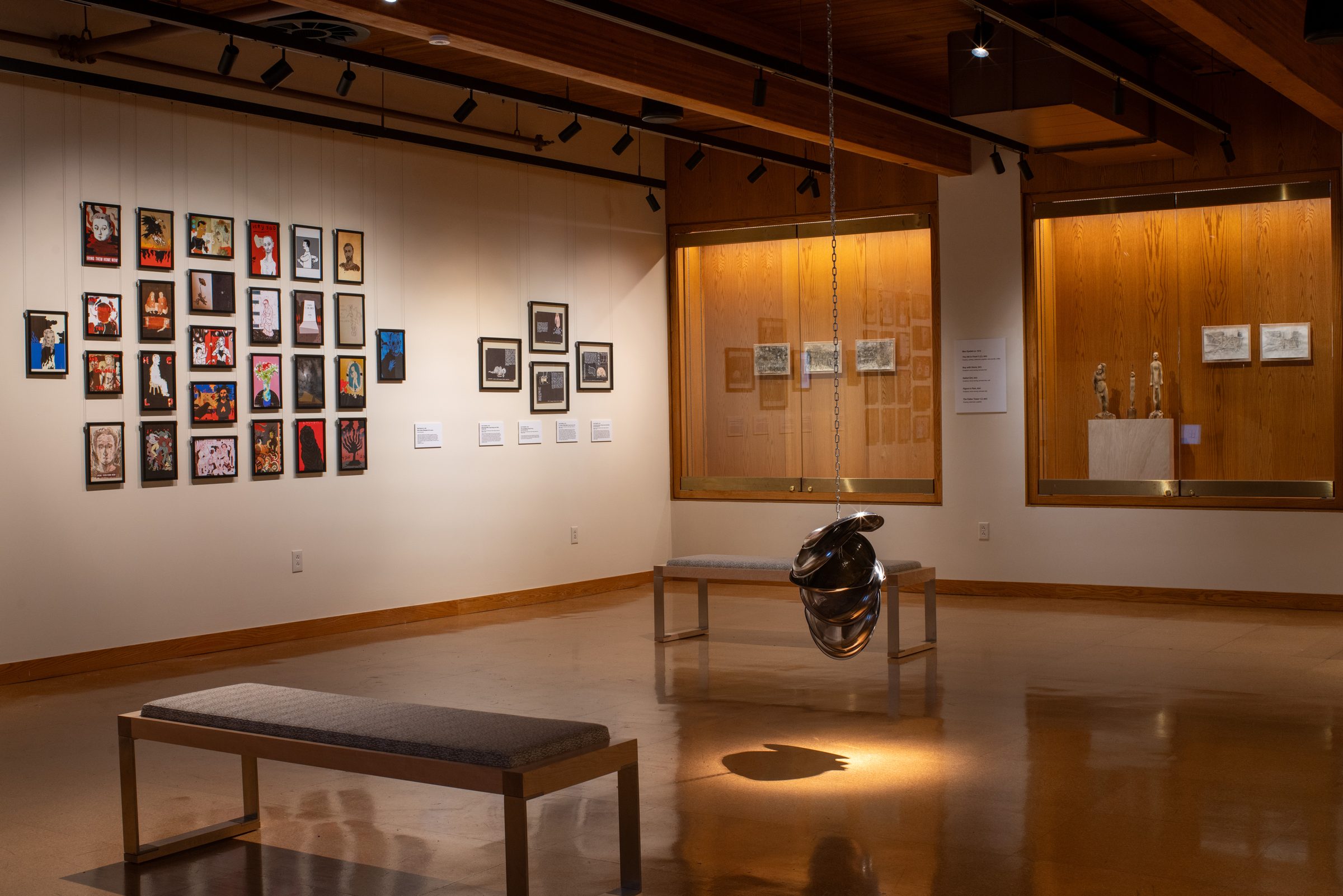
Exhibition view
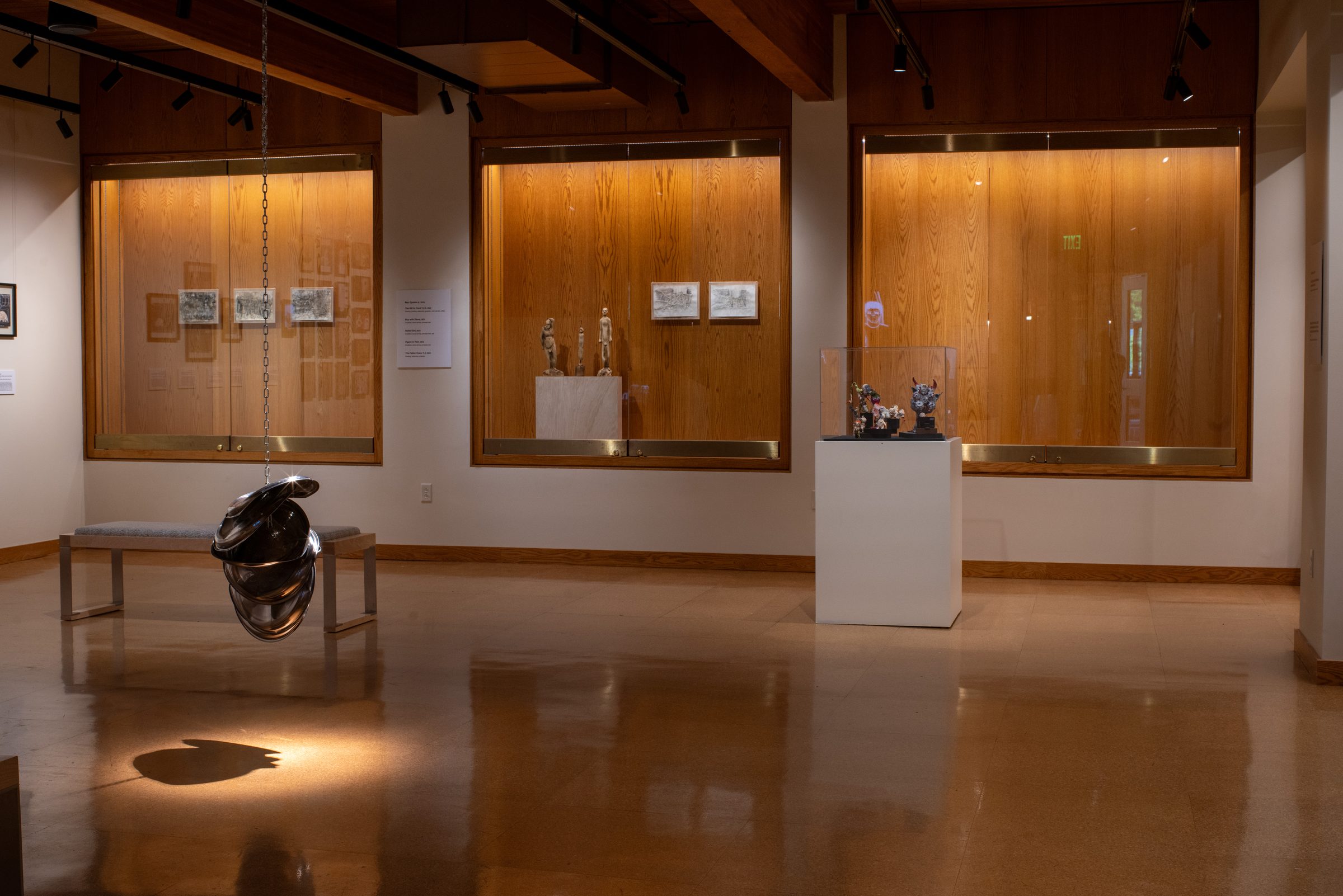
General view
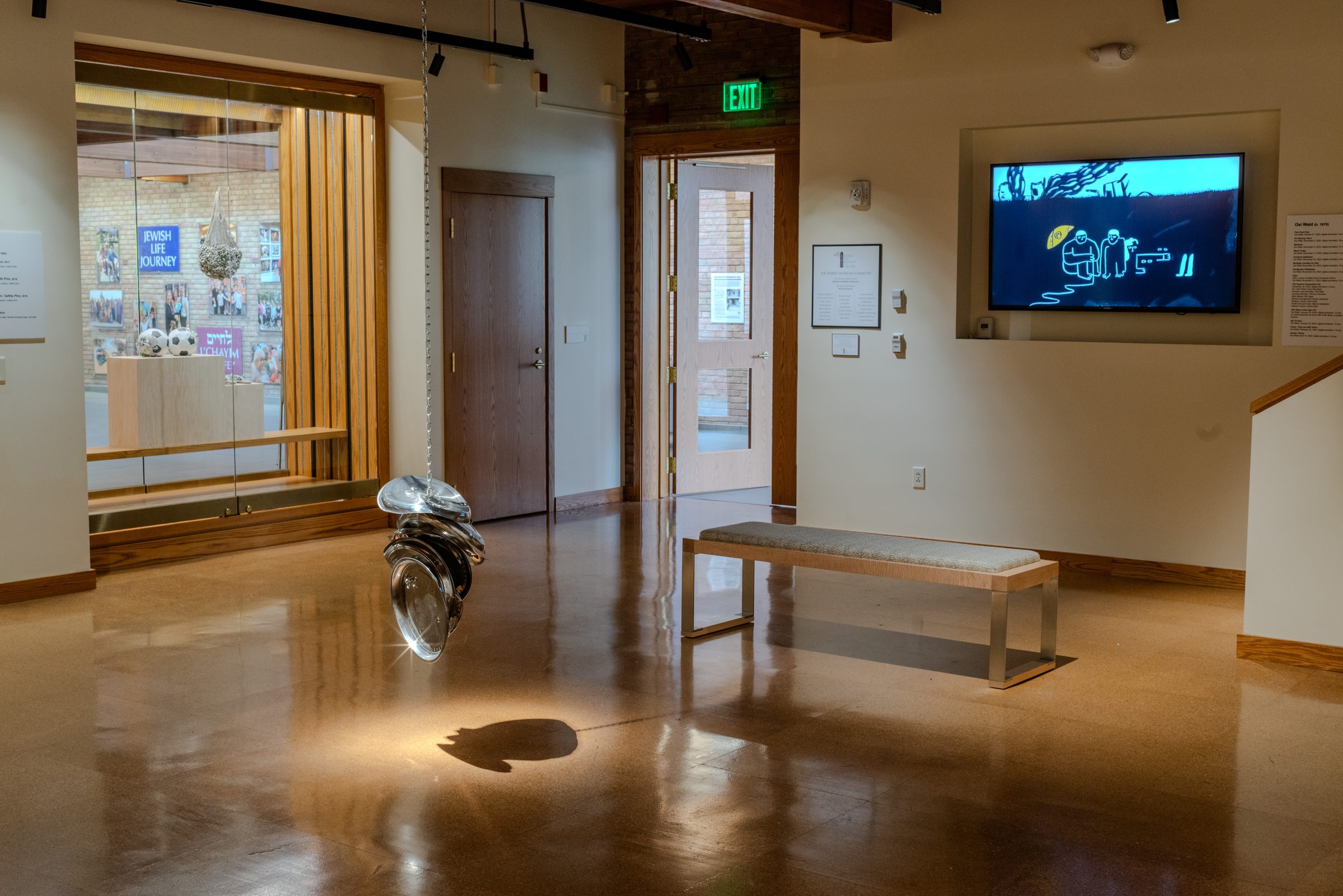
General view
The terrible events of October 7 and their aftermath continue to be an omnipresent element of our life. To voice the ongoing experiences of Israelis during this difficult time and to connect them to our congregation, our museum launched the project “From Israel. Now”, featuring artworks produced by leading and emerging Israeli creatives in response to or reflecting on the Hamas attack and the ensuing war.
It is difficult to see history enacted in the course of one’s life, as this enactment is always disruptive and painful. Yet, more than ever in “historic” times, art comes forth as the primal human ability to give an image to the overwhelming emotion and confusion arising in us in response to the menacing and changing world – the world that does not wait for us to adjust our processing capabilities to the speed and ferocity of challenges it throws at us.
Artists working now feel the necessity to bear witness to the extremity of change and emotion. This witnessing takes different forms. Some people produce every day; others feel utterly paralyzed. Art practice becomes therapy or refuge or just a familiar activity that allows one to get by and is often accompanied by feelings of helplessness, inadequacy, and futility of efforts. Nevertheless, they do it. No heroism. That’s just all they have and by extension, in the meantime, that is also all we have. In the meantime, memory has already begun its work, so that the artworks on display are becoming the building blocks of future recollection.
Katya Oicherman, Curator
Etti Abergel
(b. 1960) Artist, sculptor, teacher
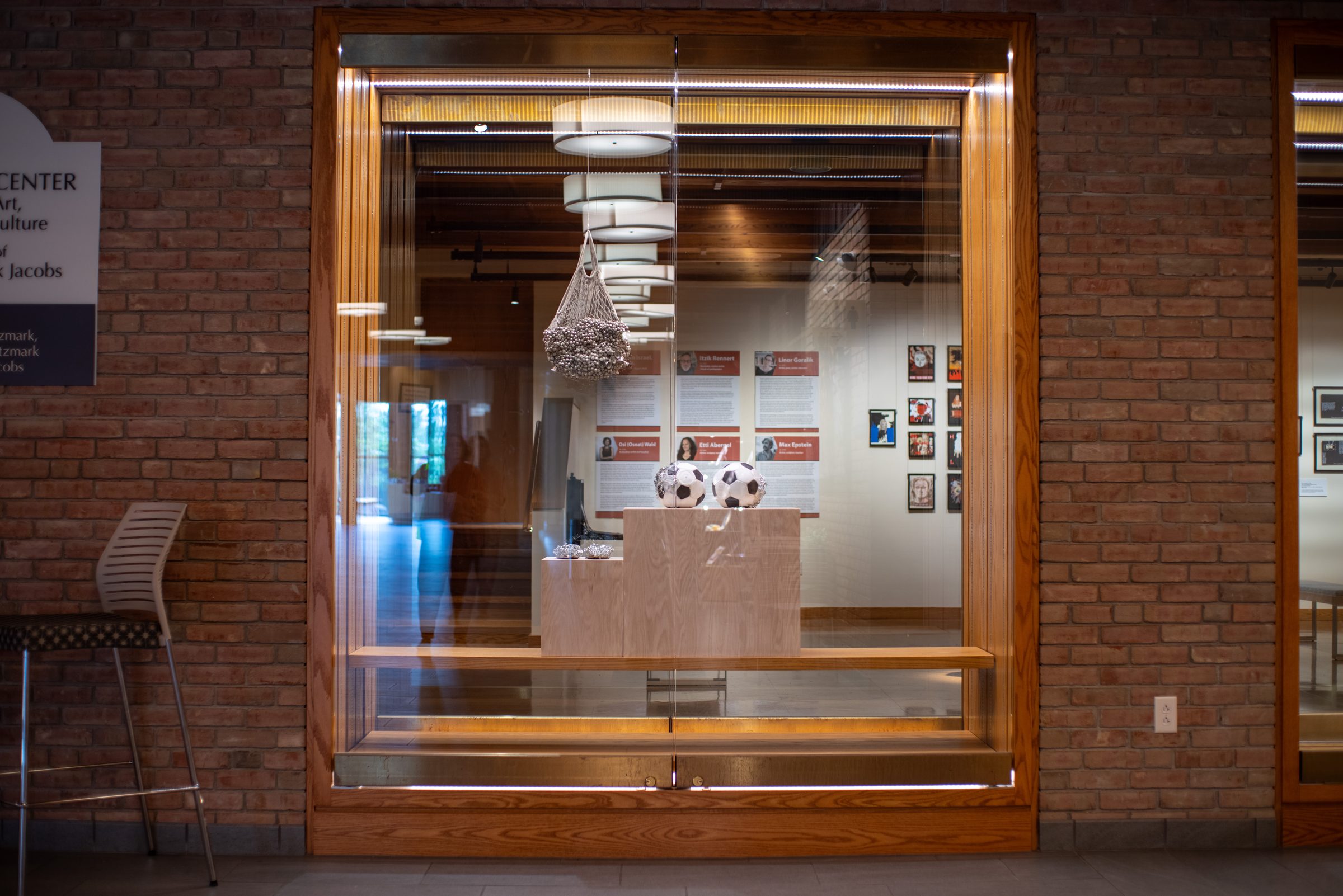
Etti Abergel, showcase
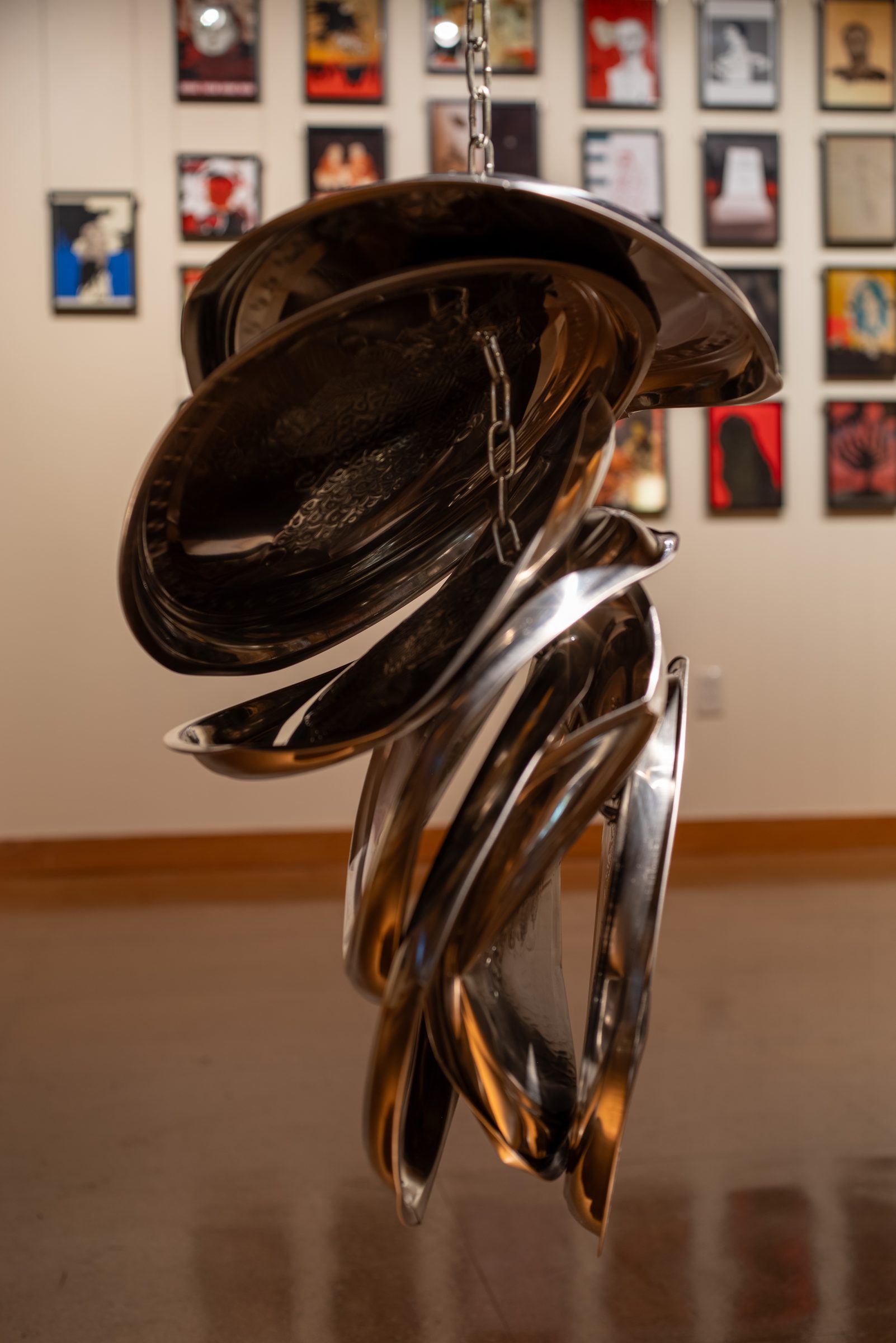
Etti Abergel, Trays Pendulum, 2017; sculpture; aluminum trays, metal chain
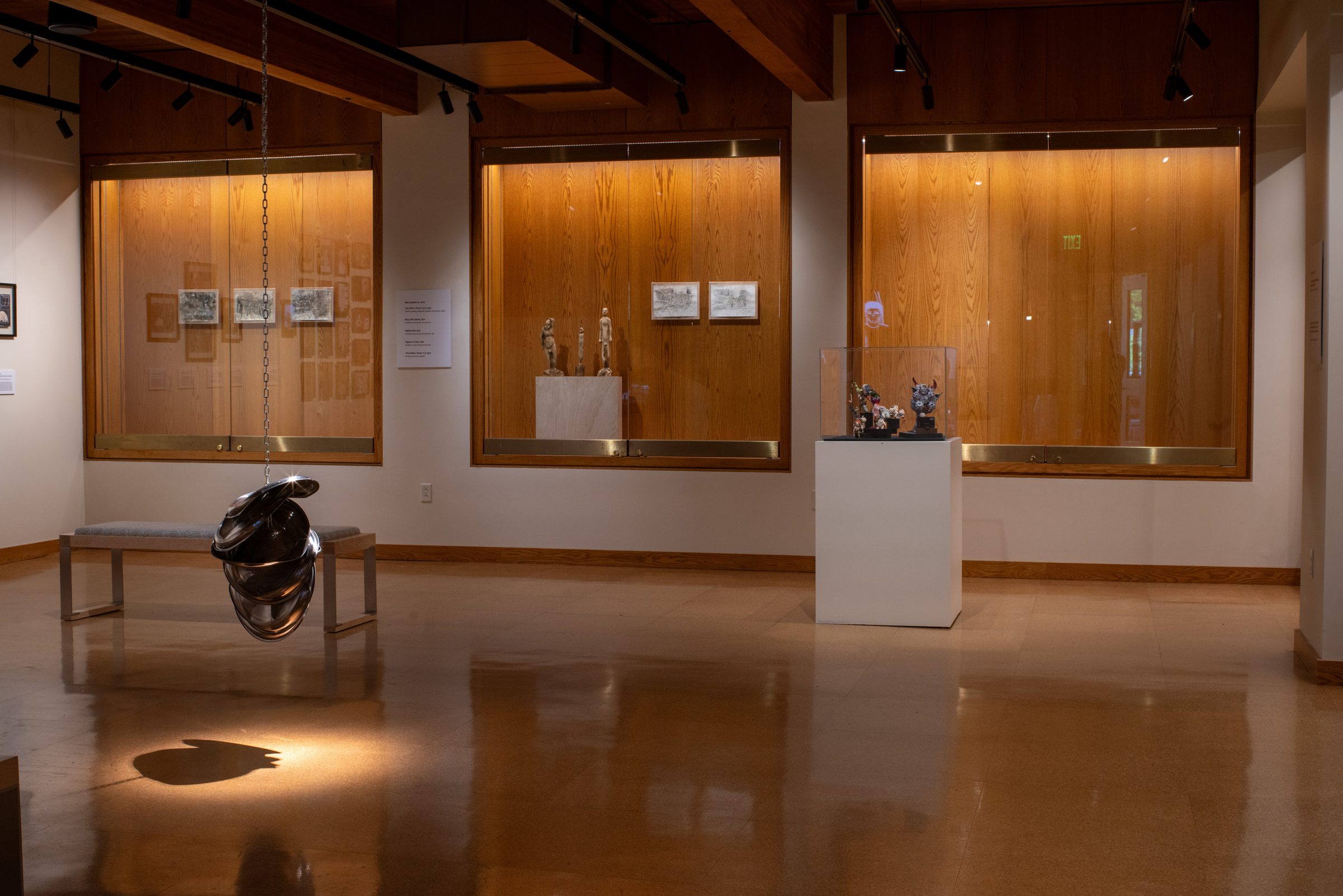
Etti Abergel, Trays Pendulum, 2017, general view
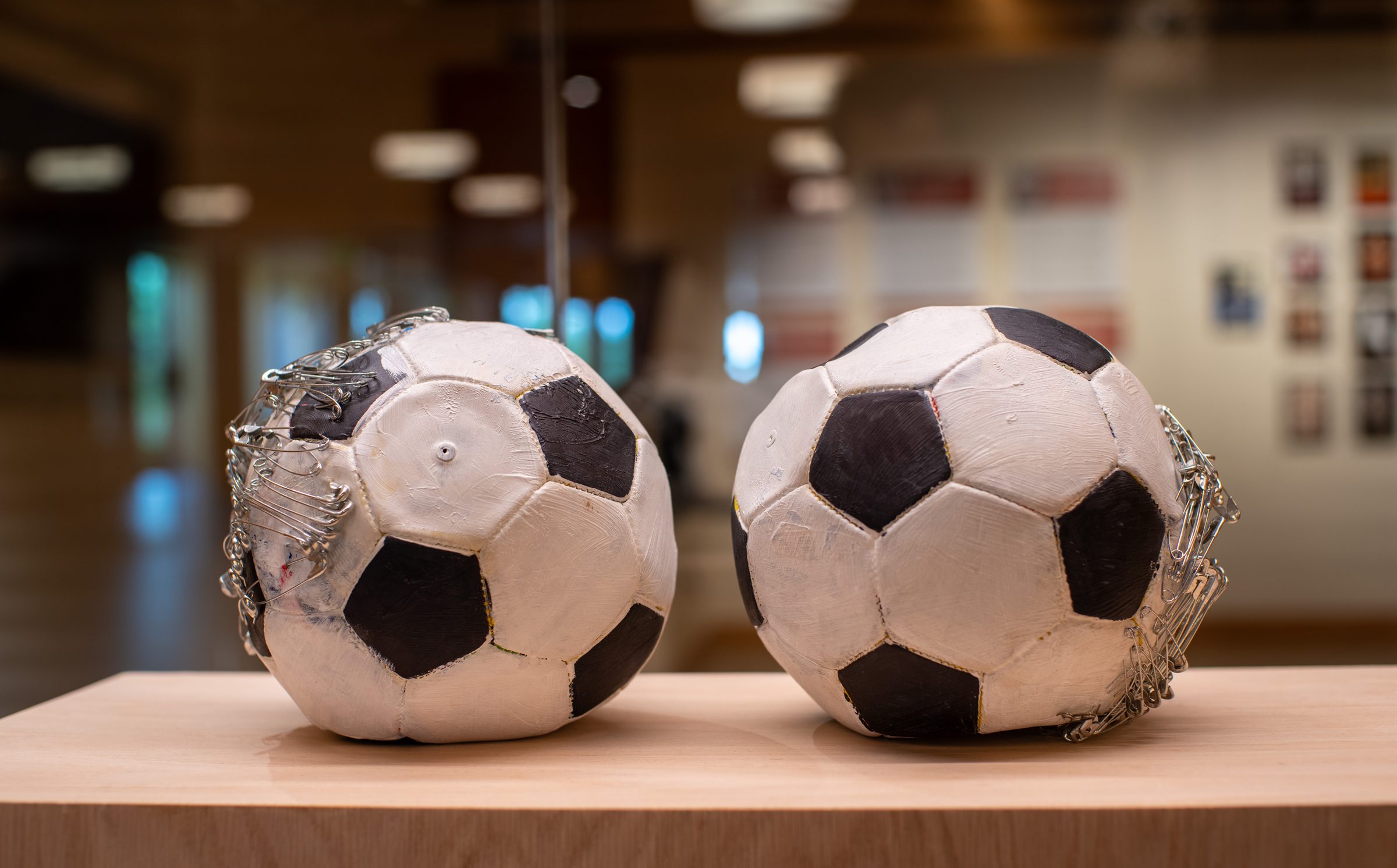
Etti Abergel, Safety Pins Footballs, 2018; sculpture; 2 footballs, gesso, safety pins
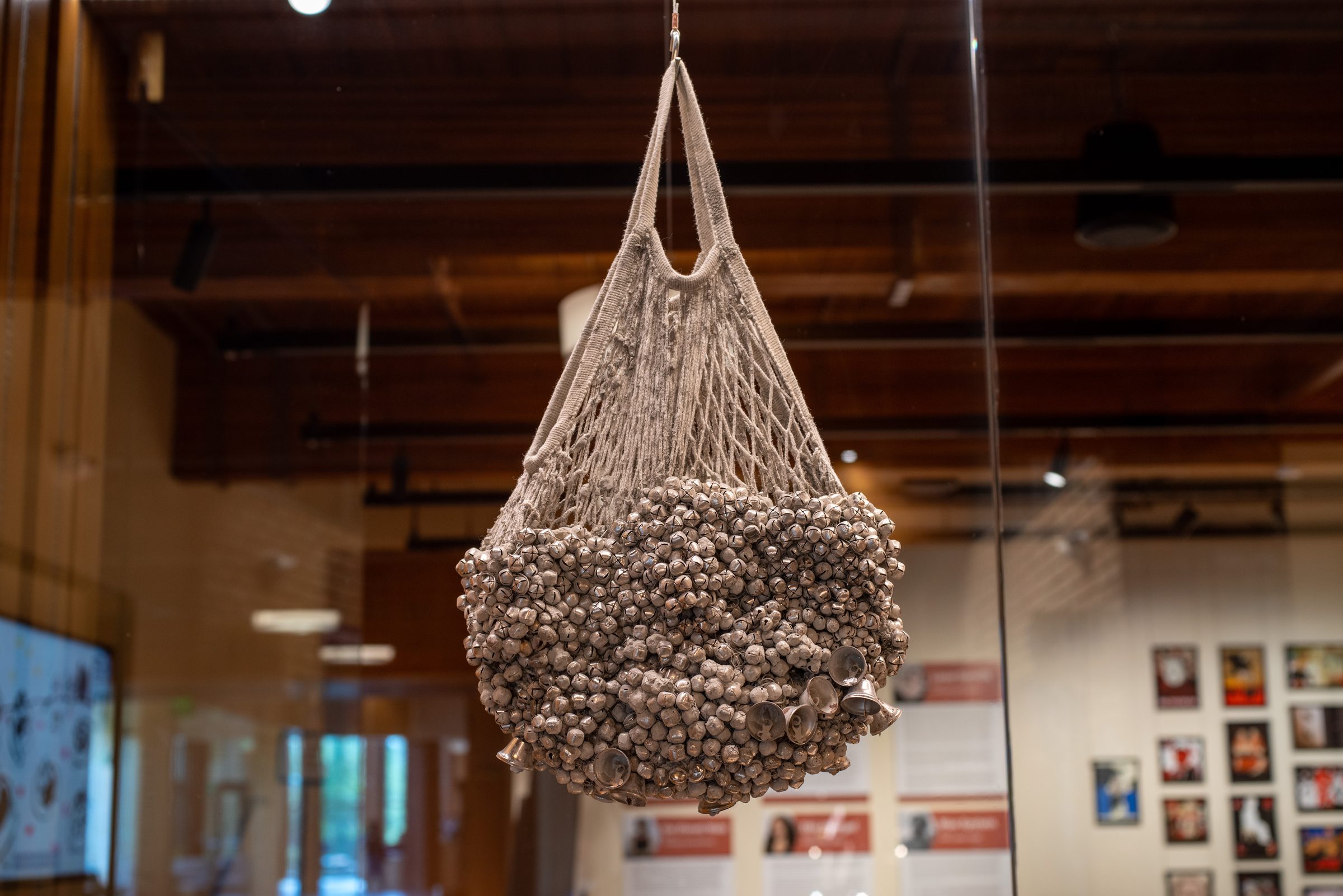
Etti Abergel, Bell Basket, 2019; sculpture; aluminum bells, fishnet shopping bag, concrete
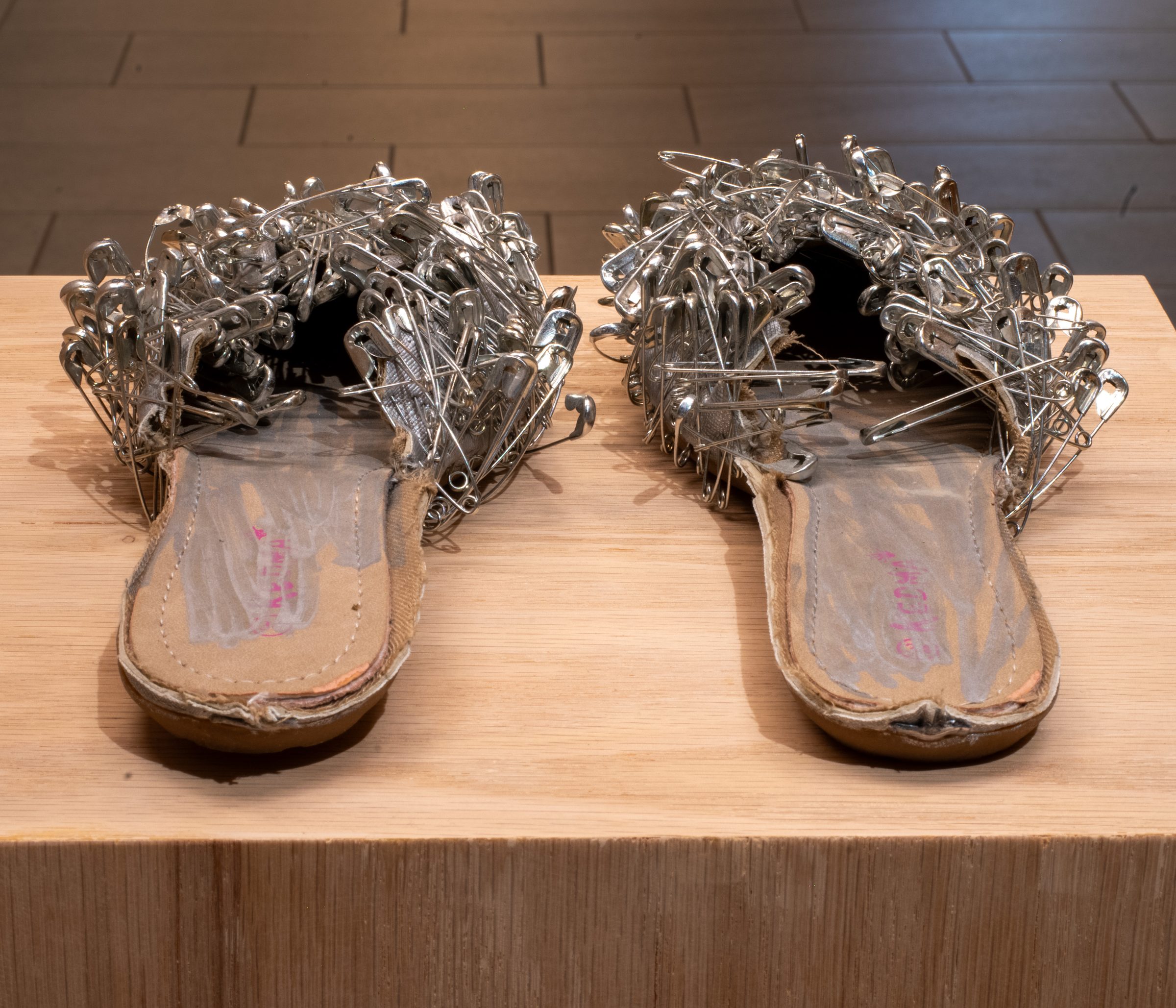
Etti Abergel, Home Slippers / Safety Pins, 2019; sculpture; slippers, gesso, safety pins
The unlikely “heroes” of Etti Abergel’s sculptures and installations come from cheap, mass-produced stuff, easily procurable in any disheveled market or outlet for domestic and office supplies. Graveyards of consumerist existence, such places are now ubiquitous and almost timeless. They offer metal trays, so thin that they could hardly perform their intended function; soundless tin bells; vinyl footballs; oriental looking slippers, props rather than footwear.
Through Abergel’s touch those failures of things are spared and elevated, almost in accordance with the Talmudic rule of elevation to sacredness. The closer an object is to the Torah scroll, the more sacredness it absorbs and thus (at least in theory) is spared oblivion and discarding. This link to Jewish observance is not opportunistic. Abergel, born in Israel, comes from a religious family of Moroccan Jews who, while deeply embedded into Israeli life, keep their customs alive. Unsurprising then, that the flimsy bent trays forming the bob of the Trays Pendulum, have an image of a grapes cluster engraved on them, a sad ironic reminder of the exuberant fruit from the Land of Canaan brought to Moses by the two good spies.
The acute contemporaneity of Abergel’s practice relies exactly on this ability to connect concepts, histories and generalized autobiographical references, processing them into striking or “puncturing” material images. Her radical adoption of the faceless ready-made and almost violent assemblage techniques serves to deliver an essentially refined sense of detachment and homelessness in the Israeli art landscape of a Mizrahi woman artist. Bold and pathetic gestures co-create the sculptural images together with minuscule and repetitive ones. Fine art gesso covers the objects together with security pins and concrete, so that the “sublime” and the “mundane” merge in the attentive and wild touch of the artist’s hands.
Abergel found herself unable to create new work in the aftermath of October 7. Instead, she rigorously rearranged and reimagined an immense body of work produced before. It was chilling but also inspiring to find among the vastness of her output the objects we selected together for the exhibition. Prophetic and painful, they appeared as future memories.
Etti Abergel studied at the Bezalel Academy of Arts and Design, Jerusalem, and taught for many years in Bezalel and other Israeli art schools. She began exhibiting in the mid-1990s, with significant recognition arriving in 2003 through an invitation to participate in the Venice Biennale. Since then, Abergel has shown her work extensively in Israel, Europe, and the USA. In the last two years, she left Jerusalem where she lived and worked for a long time and returned to Kiryat Tivon, in northern Israel, leaving behind all formal teaching responsibilities and dedicating her time to art practice.
Max Epstein
(b. 1974) Artist, sculptor, teacher
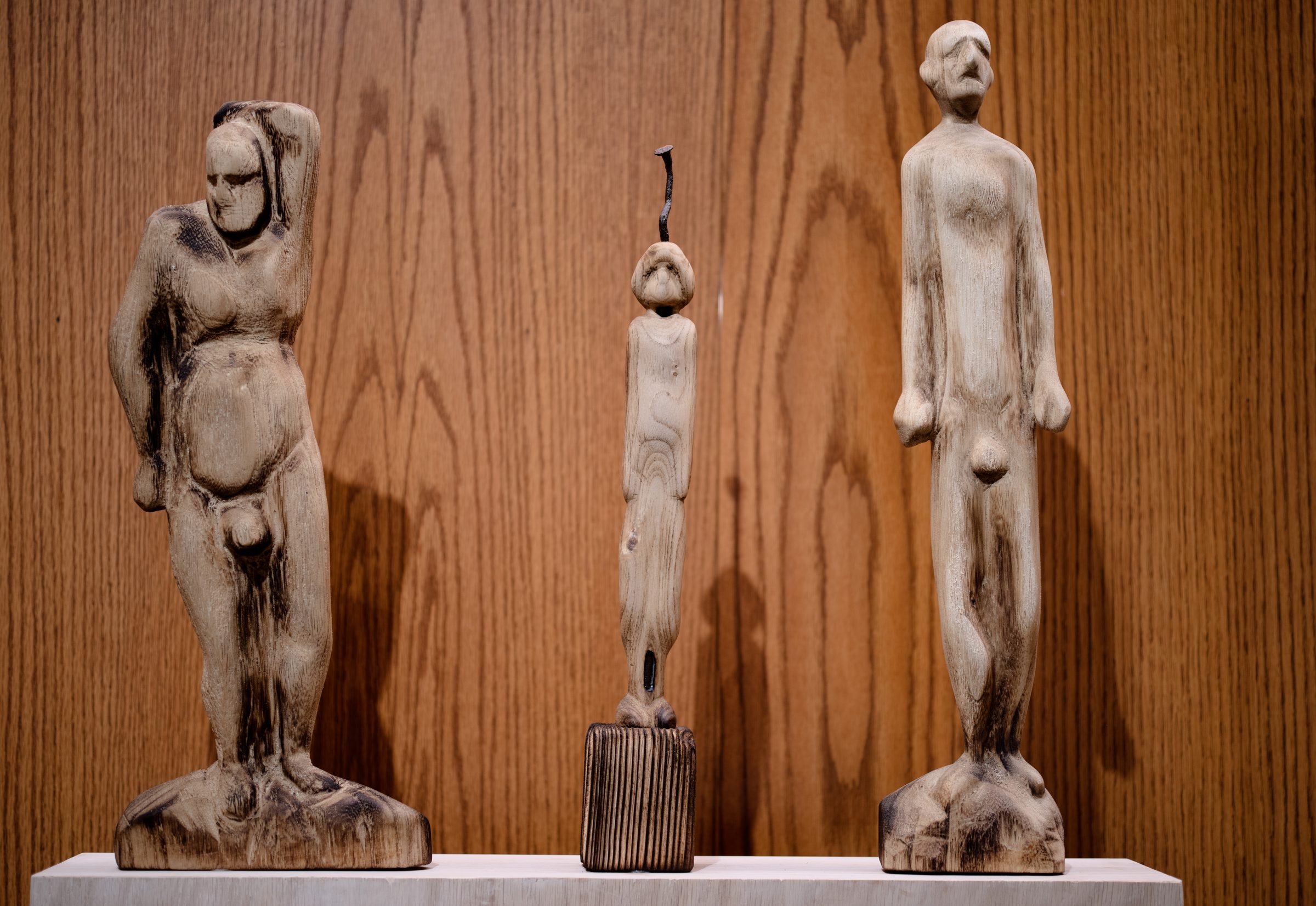
Max Epstein, Boy with Stone, Nailed Girl, Figure in Pain, 2023–24; sculptures; wood carving; princess tree
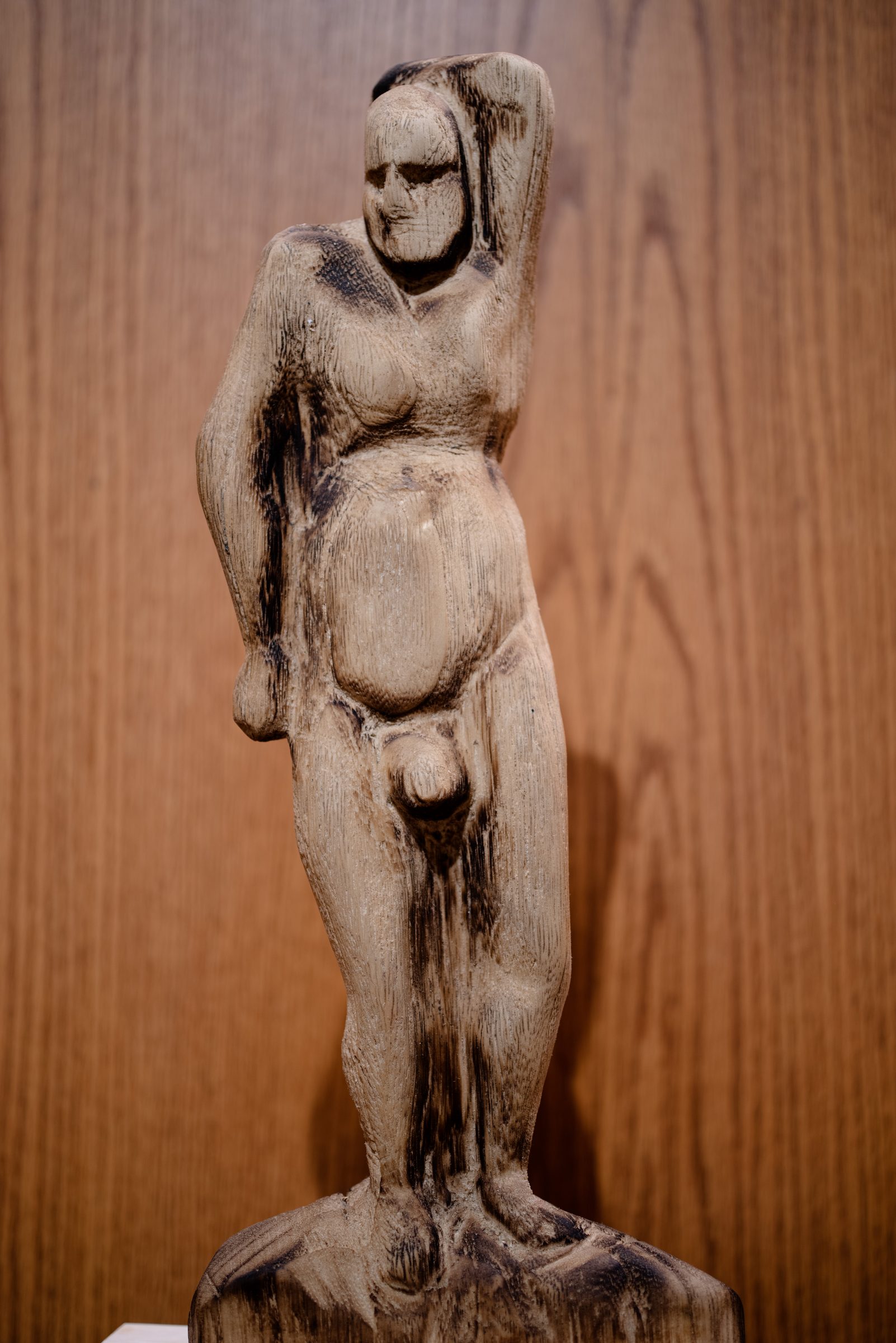
Max Epstein, Figure in Pain, 2024; sculpture; wood carving; princess tree
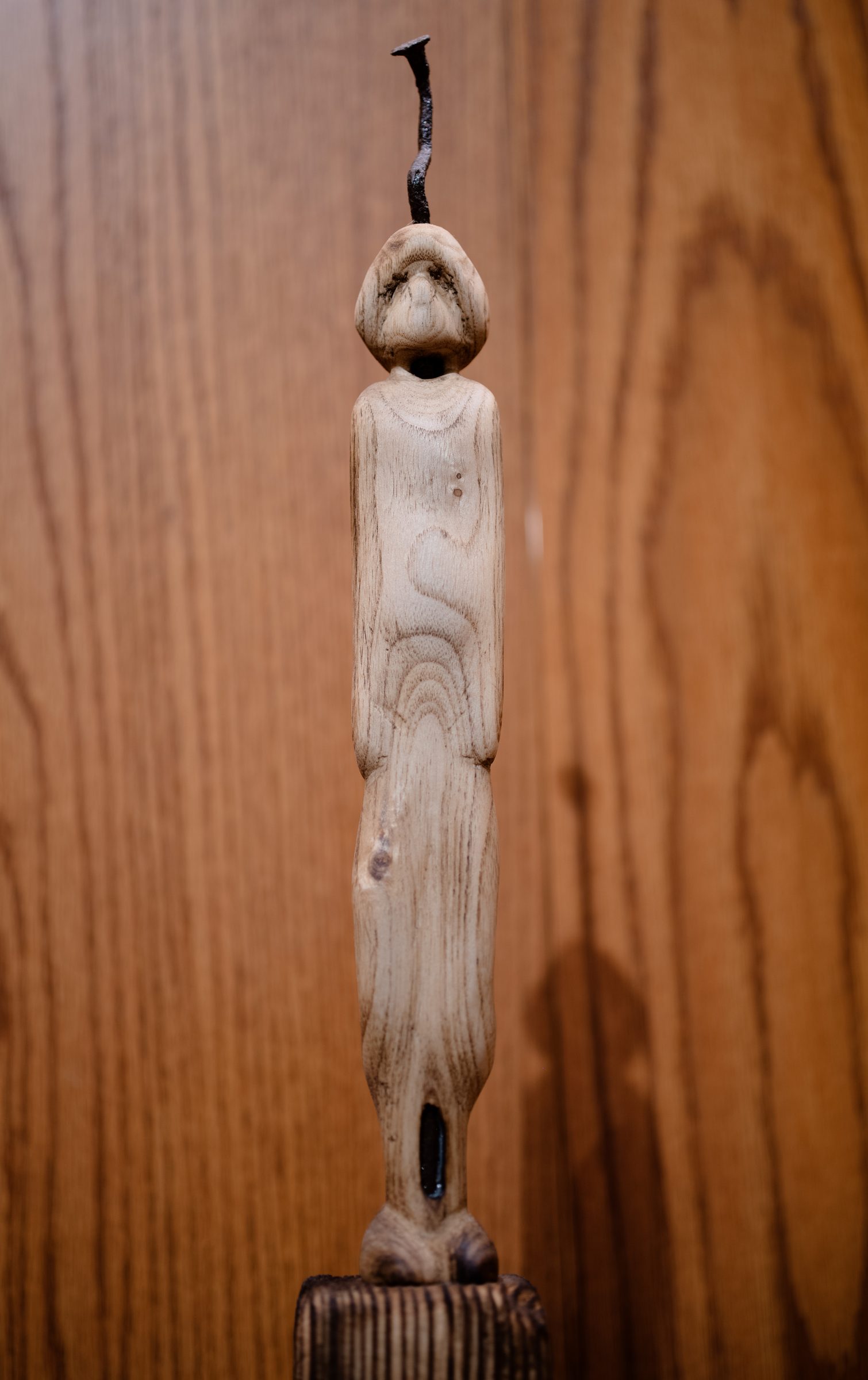
Max Epstein, Nailed Girl, 2023; sculpture; wood carving; princess tree
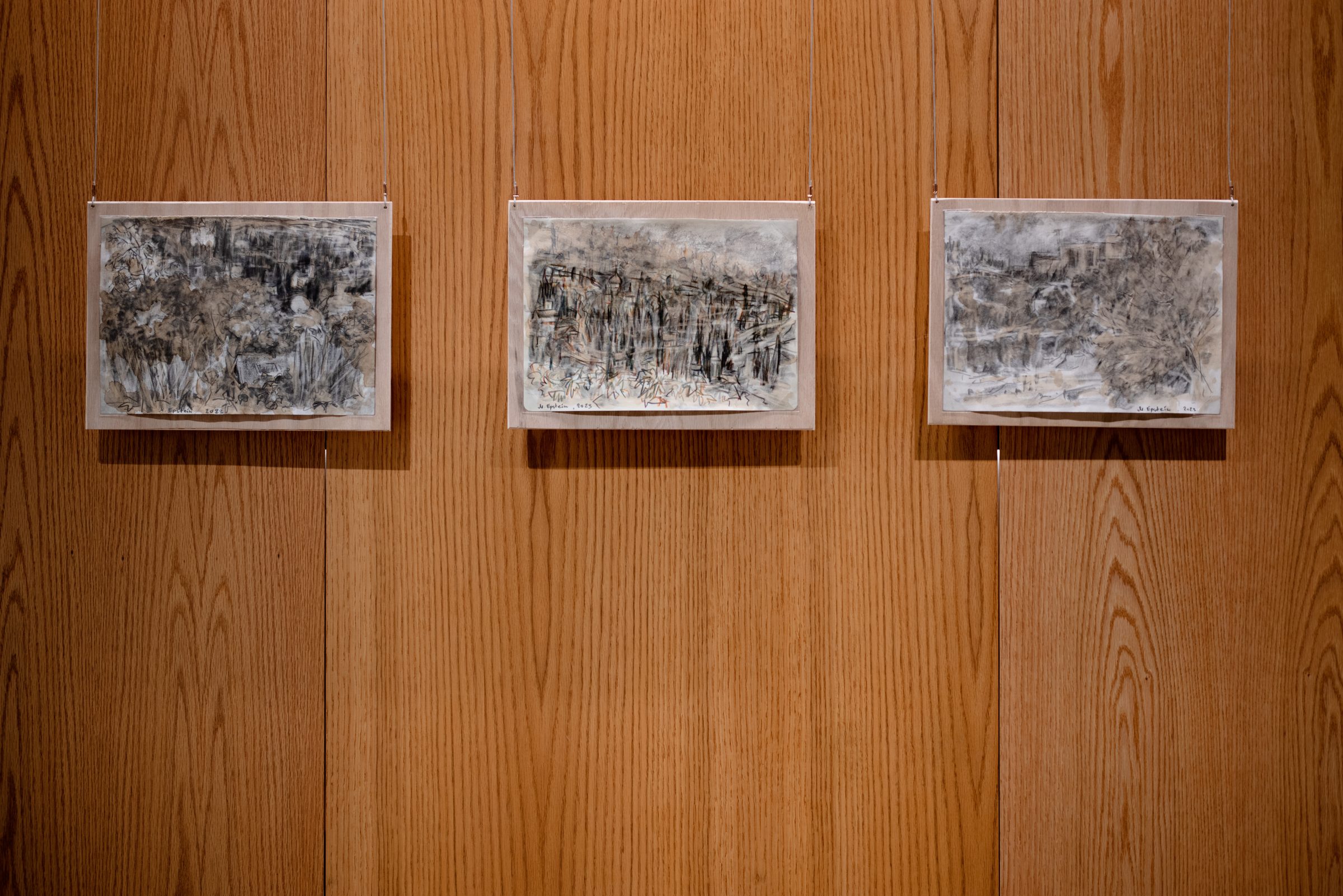
Max Epstein, The Hill in Front 1,2,3, 2023; watercolor, graphite, color pencils, coffee
Max Epstein is an artist and educator working in the juncture of sculpture, painting, photography, animation, and performance. Drawing on the Western tradition rooted in observation of peoples and landscapes, he also examines the sculptural potential of an eccentric found object and the hybrid three-dimensional language that results from the juxtaposition of the found and the created. Encounters with the city of Jerusalem, his primary residence for 25 years, its people and animals are often the main subjects of his attentive and emphatic observations, evoking a sense of elaborate tension between belonging and homelessness. At the same time, the memory of his Soviet childhood left behind comes through repeatedly in his work as a visual mythology reflecting family stories and historical events.
Epstein’s art intentionally abstains of immediate commentary and direct political engagement. This is also the case in the works presented here. Grief reveals itself, subdued and restrained, in the carved wooden sculptures, small, but appealingly monumental. Patches of erasures and erratic strokes compose themselves into a distressed landscape. Epstein works incessantly, through a daily routine that begins with an early morning drawing session on the terrace overlooking the picturesque Ein-Kerem neighborhood. The routine has not changed, but the sounds of explosions and sirens often interject into the familiar everyday accompaniment of monastery bells and car horns. “My watch tower was knocked over,” he says, injecting an expletive. The fallen watch tower, prominently featured in two drawings presented here, so unavoidably resonating with Israel’s failure to protect its people, for Epstein is a personal symbol, pointing to the broken dream of a curious, disinterested and independent observation.
Over 10 years ago Epstein co-founded a unique, internationally recognized animation studio “Wild Kids” that provides creative education for children and teenagers, ranging their activities from animation classes for all ages to projects developed as part of the matriculation curricula for Israeli high schools. While based in Jerusalem, the studio engages with schools and diverse communities all over Israel. In the last two years, the studio created special programs for Ukrainian refugees and keeps working nonstop through in-person and online formats to emotionally support children after October 7. Epstein was born in Russia and immigrated to Israel at the age of 16. He studied at the Bezalel Academy of Arts and Design and the University of Haifa. He exhibited his work extensively in Israel and abroad.
Linor Goralik
(b. 1975) Artist, poet, writer, educator
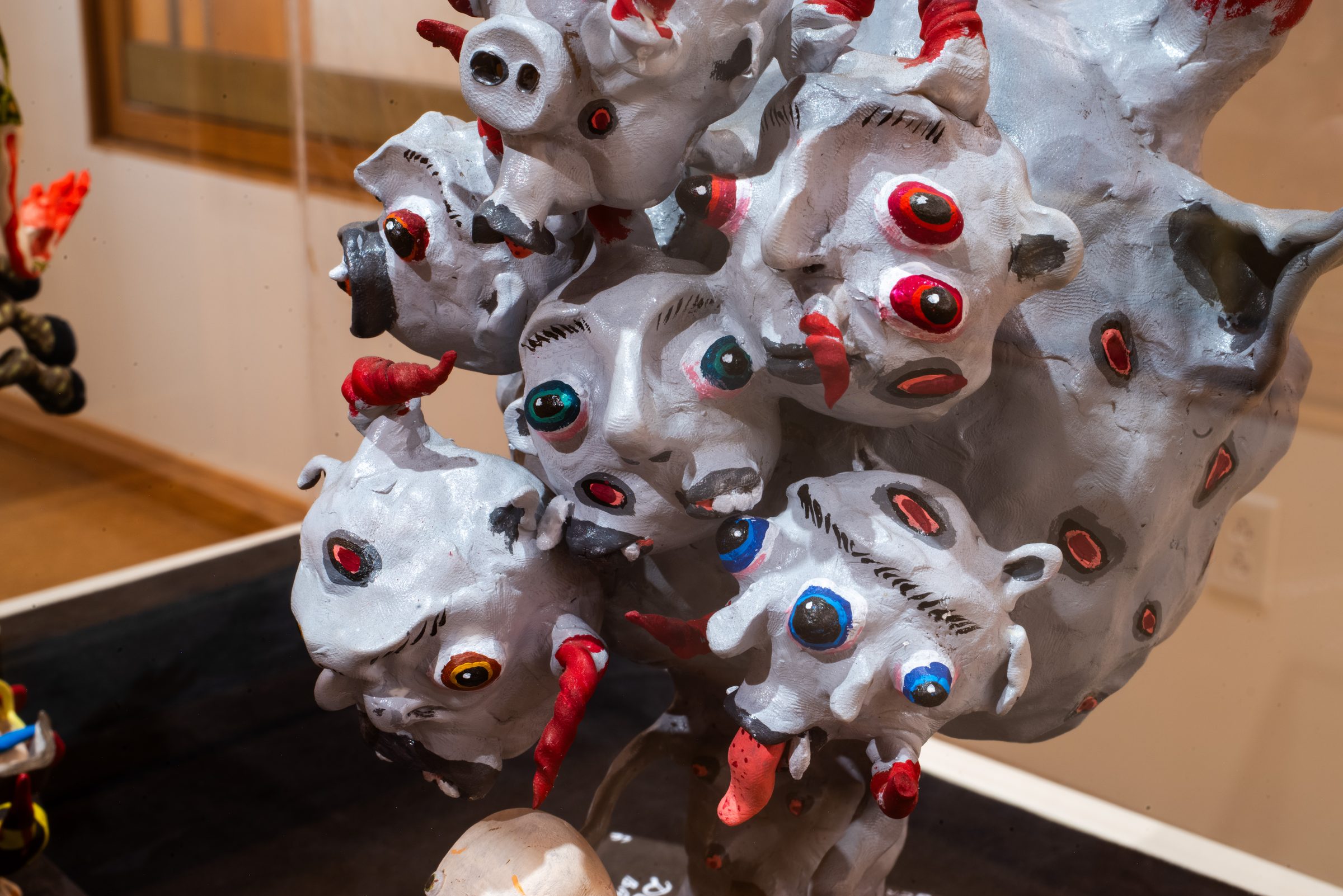
Linor Goralik, Darling, You Don’t Have to Ask Us Daily How We Are Doing Here. We Just Try to Stay Calm and Look Forward with Hope, 2024; sculpture; polymer clay, aluminum, gouache, wood
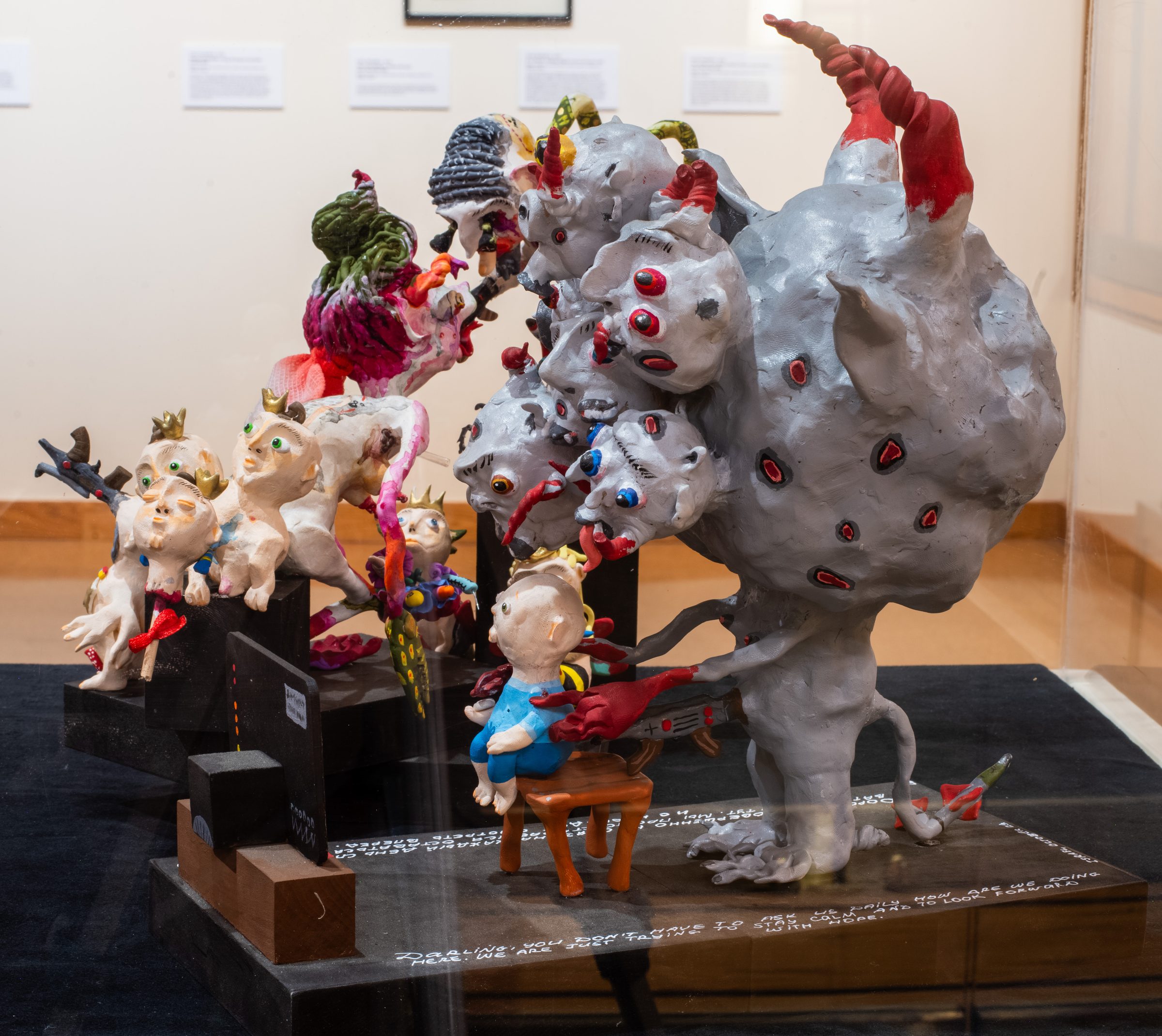
Linor Goralik, Darling, You Don’t Have to Ask Us Daily How We Are Doing Here. We Just Try to Stay Calm and Look Forward with Hope, 2024; sculpture; polymer clay, aluminum, gouache, wood
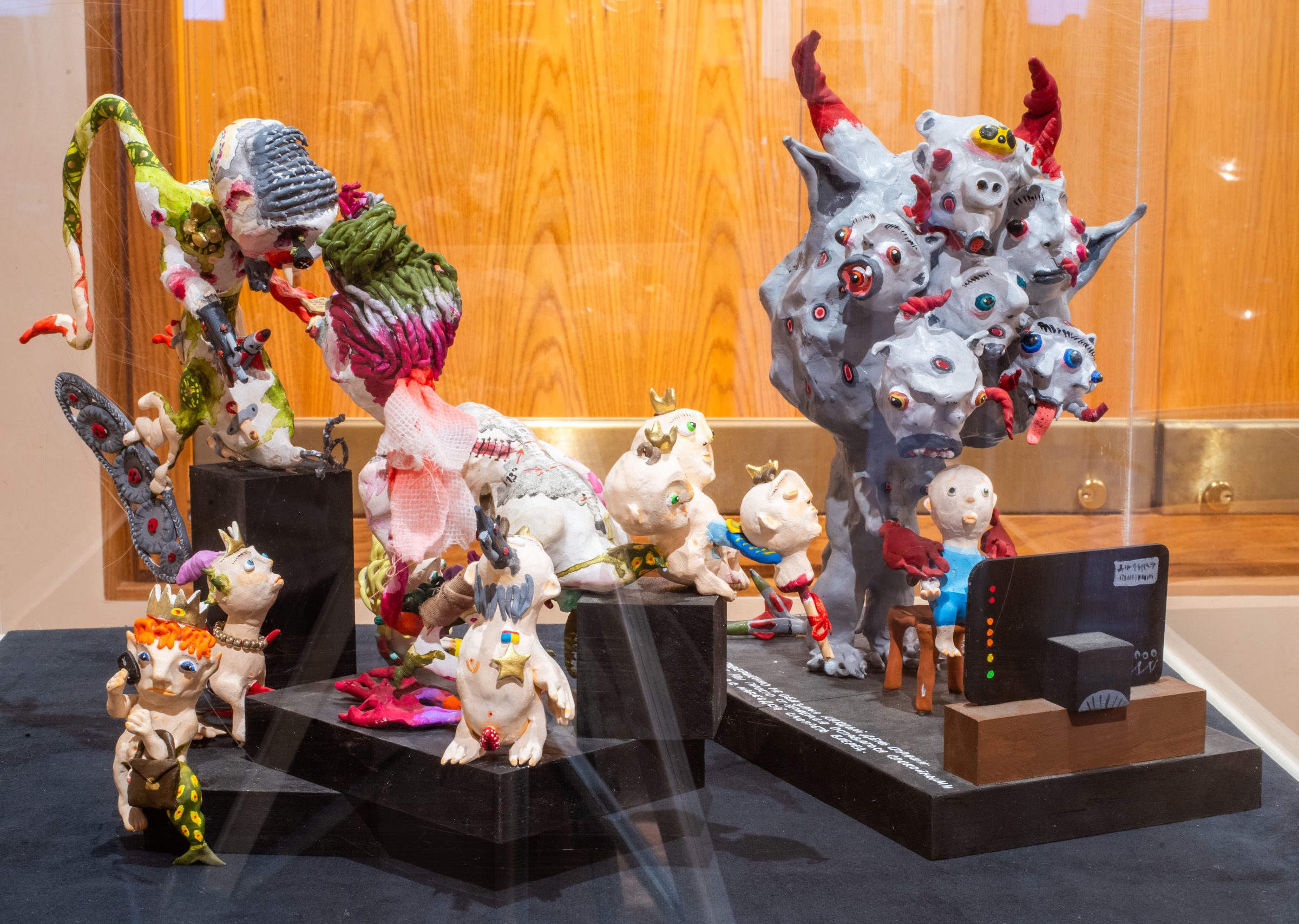
Linor Goralik, War and Plague with Their Offsprings, the State Portrait, 2023, and Darling, You Don’t Have to Ask Us Daily How We Are Doing Here. We Just Try to Stay Calm and Look Forward with Hope, 2024; sculptures; polymer clay, aluminum, gouache, wood
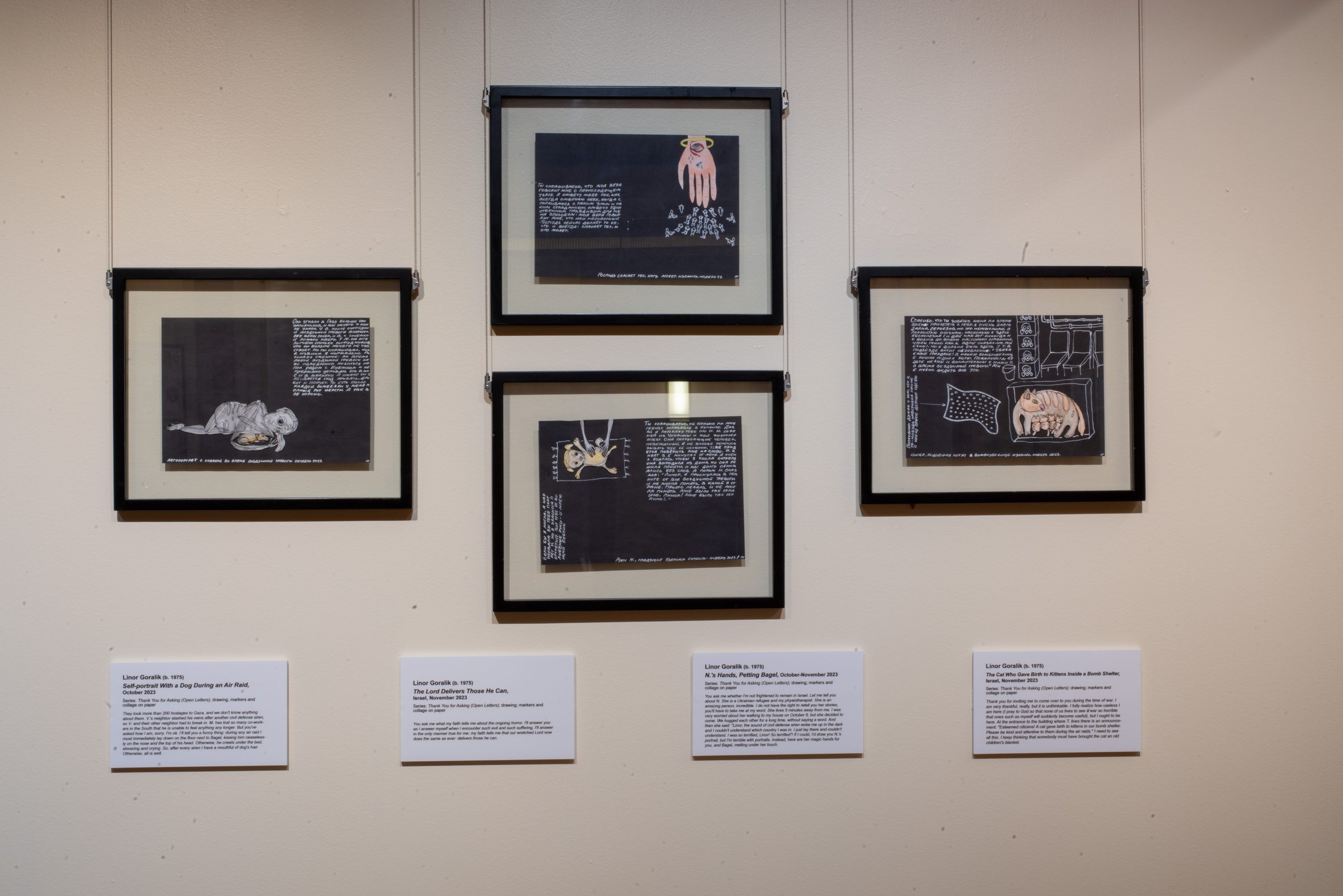
Linor Goralik, from the series Thank You for Asking (Open Letters), 2023: Self-portrait With a Dog During an Air Raid; The Lord Delivers Those He Can; N.’s Hands, Petting Bagel; The Cat Who Gave Birth to Kittens Inside a Bomb Shelter; markers and collage on paper
Goralik was born in the Soviet Ukraine and immigrated to Israel with her parents in 1989. Between 2000 and 2014, she lived and worked in Russia, becoming a vocal opponent of Putin’s regime. When Russia’s invasion of Ukraine began in 2022, Goralik produced a series of very personal artworks that explored the relationship between war and faith. At the same time, she wrote an anti-war novel Bobo and released it for free on her personal website to avoid putting her publisher at risk. This move caused the Russian government to block her website and proclaim Goralik “a foreign agent” (literally “an enemy of the state”), making her the only Israeli “honored” by such “distinction”. She is an Editress-in-Chief of two media banned in Russia: ROAR // Resistance and Opposition Arts Review and News26 // Russian Politics for Teenagers. She also was an Editress-in-Chief of Booknik.ru, an internet portal in Russian dedicated to Jewish literature and culture. Goralik is an author of over 30 books of poems and prose in Russian and English and recently began working on her first novel in Hebrew. Her visual art has been presented in many personal and collective exhibitions worldwide.
Text and image have been closely linked in Goralik’s creative practice that includes illustrated children’s books and comics, with narrative dominating any other form of expression. “If there is no narrative, I’m just not interested,” says Goralik. As a result, her visual art is an intense form of storytelling, akin to her writing, skillfully balancing the raw, often macabre, “child-like” perspective with a profound sense of empathy and an innate religious sensation. War has always been among the central subjects of Goralik’s work, in part due to an acute war phobia experienced in her childhood.
When the war in Gaza began in October 2023, Goralik reacted with short stories, sculptures and works on paper directly connected to her own and her loved ones’ experiences. She suggests that writing and producing visual art during this time are first a form of therapy, work created in the hope of overcoming the feeling of uselessness and inability to do more. At the same time, this intense work is also a form of dreaming, a possibility to not just process the present, but to invoke future images and stories, which by their simple appearance signal a potential for alternative lives.
Itzik Rennert
(b. 1959) Illustrator, comics artist, visual art pedagogue
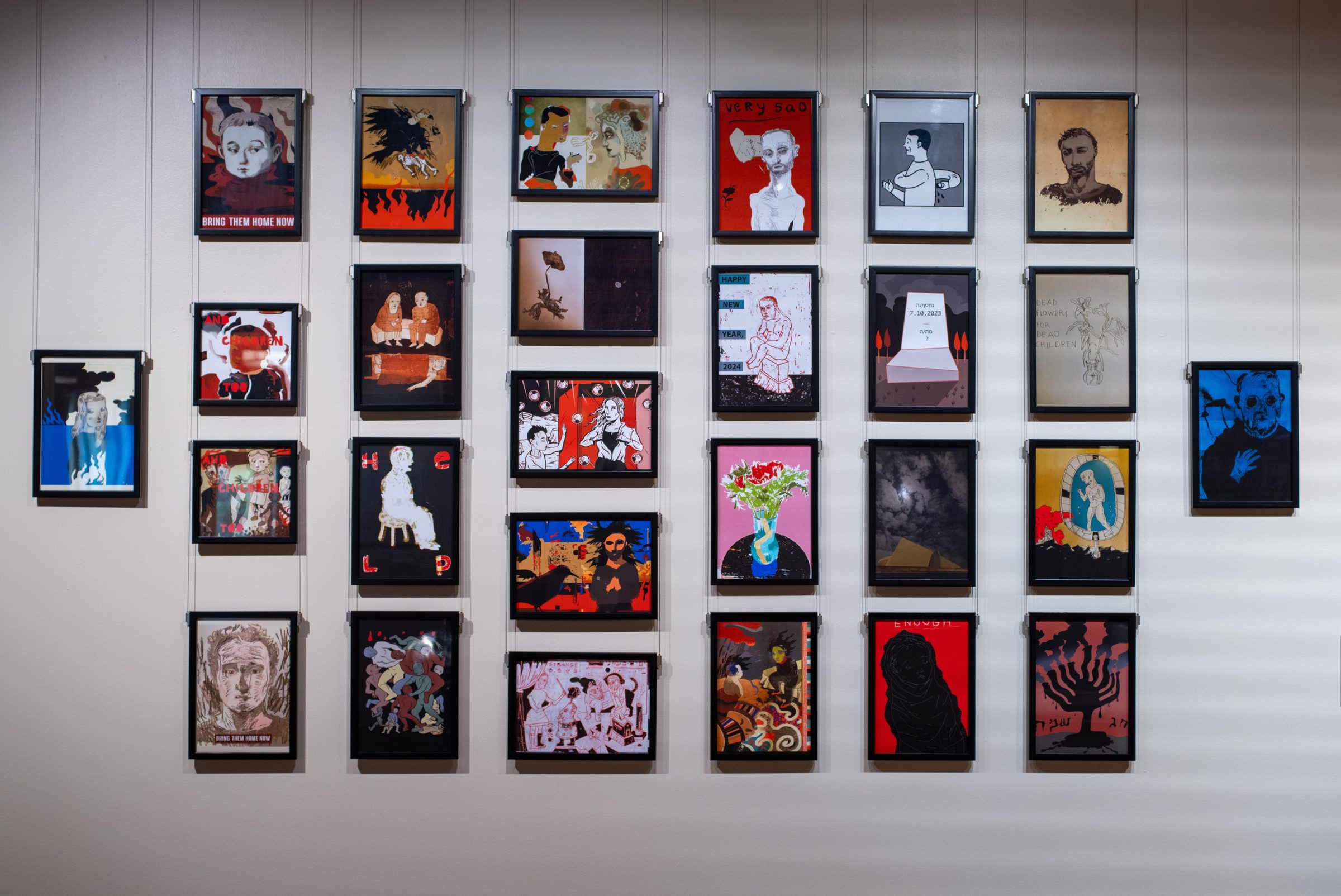
Itzik Rennert, We’ve Been Kidnapped, 2023–ongoing; archival ink-jet prints
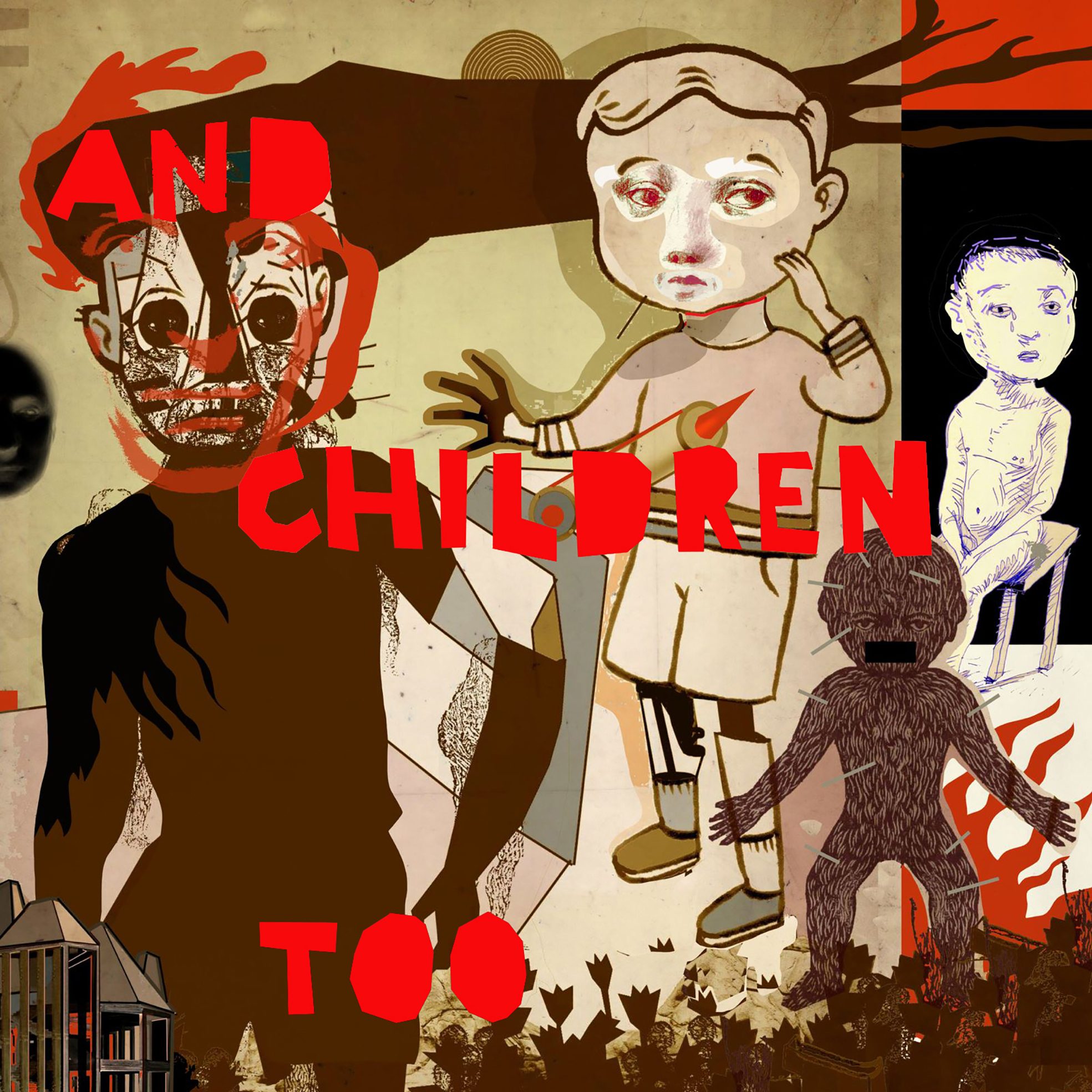
Itzik Rennert, And Children Too, from the series We’ve Been Kidnapped, 2023–ongoing; archival ink-jet print
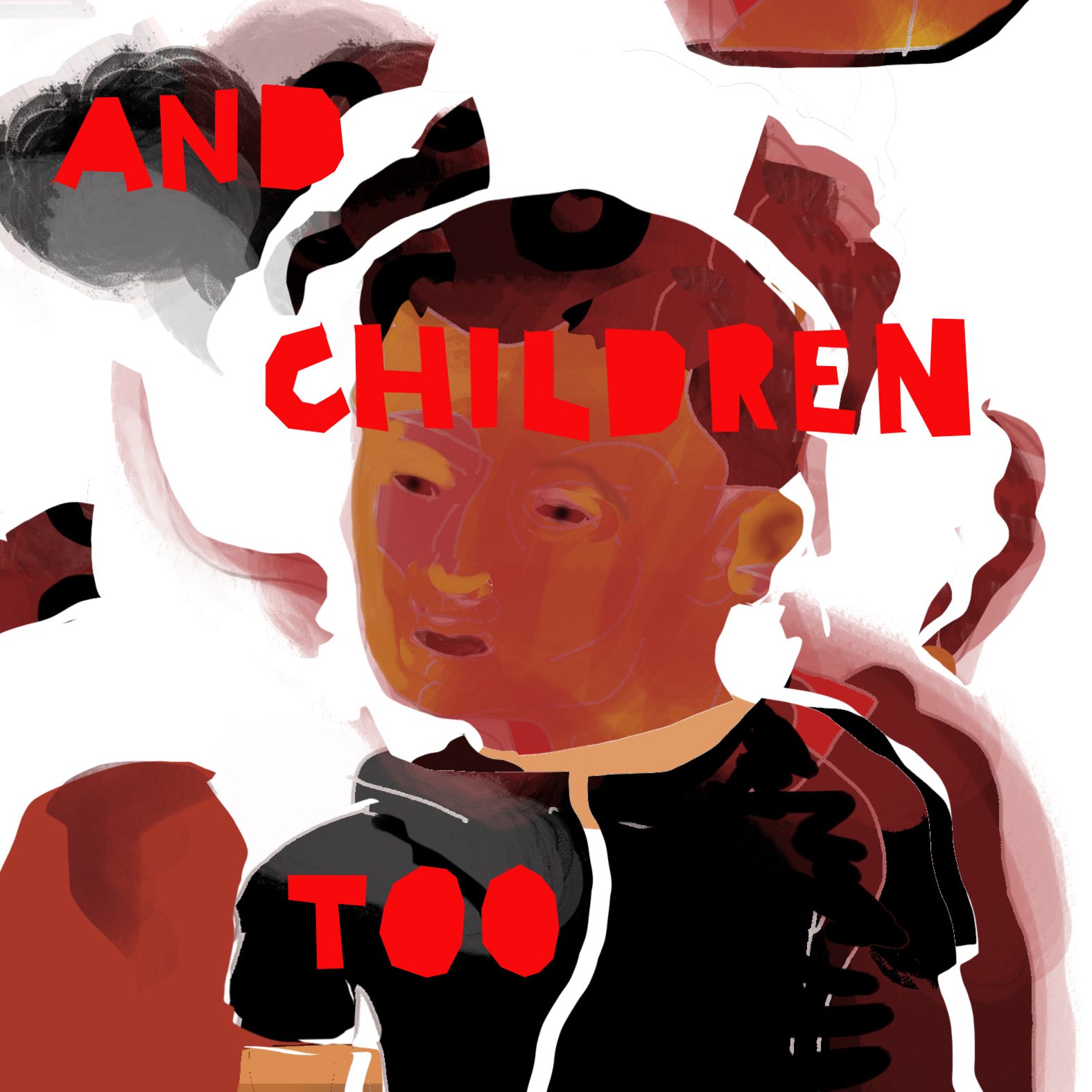
Itzik Rennert, And Children Too, from the series We’ve Been Kidnapped, 2023–ongoing; archival ink-jet print
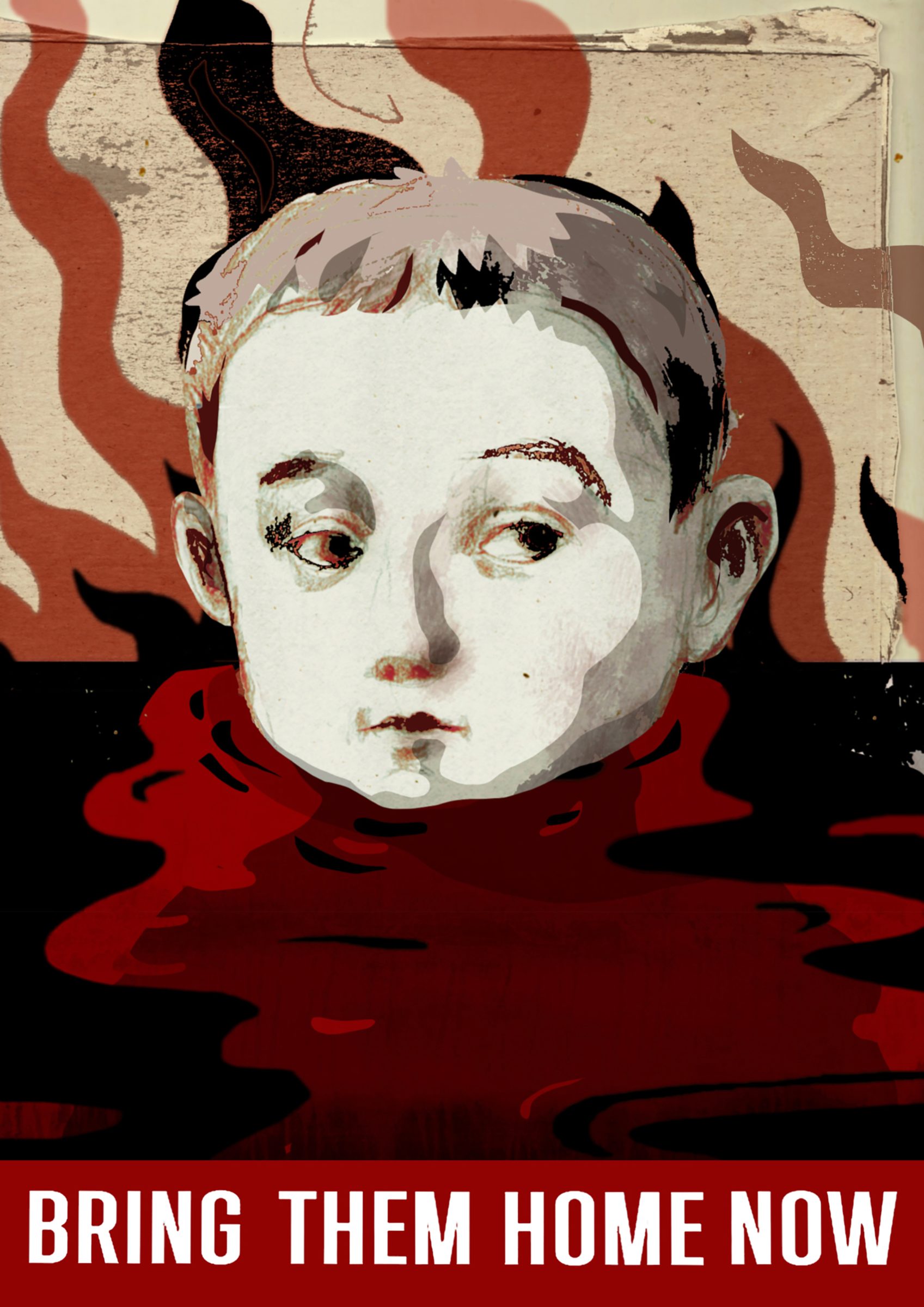
Itzik Rennert, Bring Them Home, from the series We’ve Been Kidnapped, 2023–ongoing; archival ink-jet print
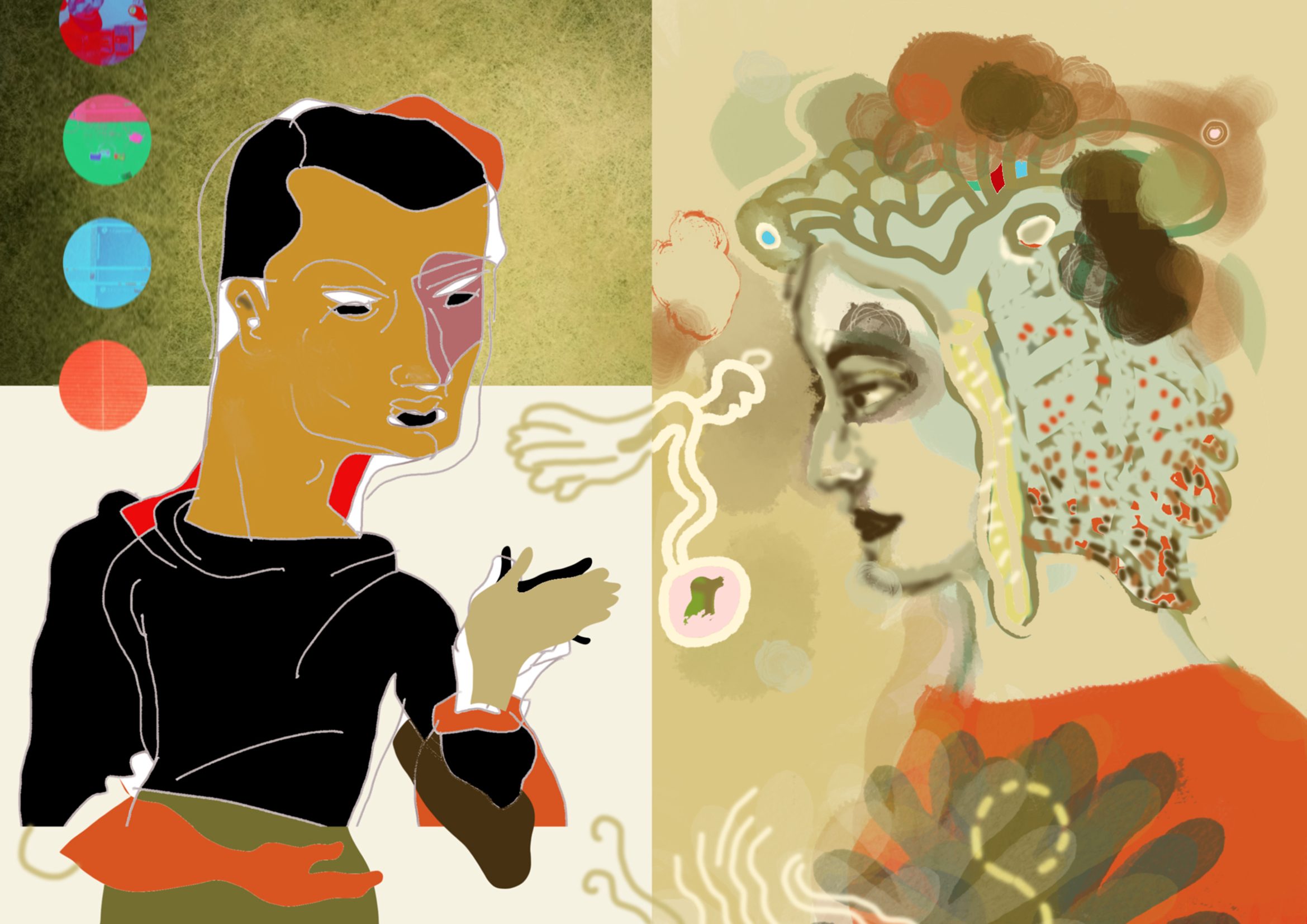
Itzik Rennert, Couple, from the series We’ve Been Kidnapped, 2023–ongoing; archival ink-jet print
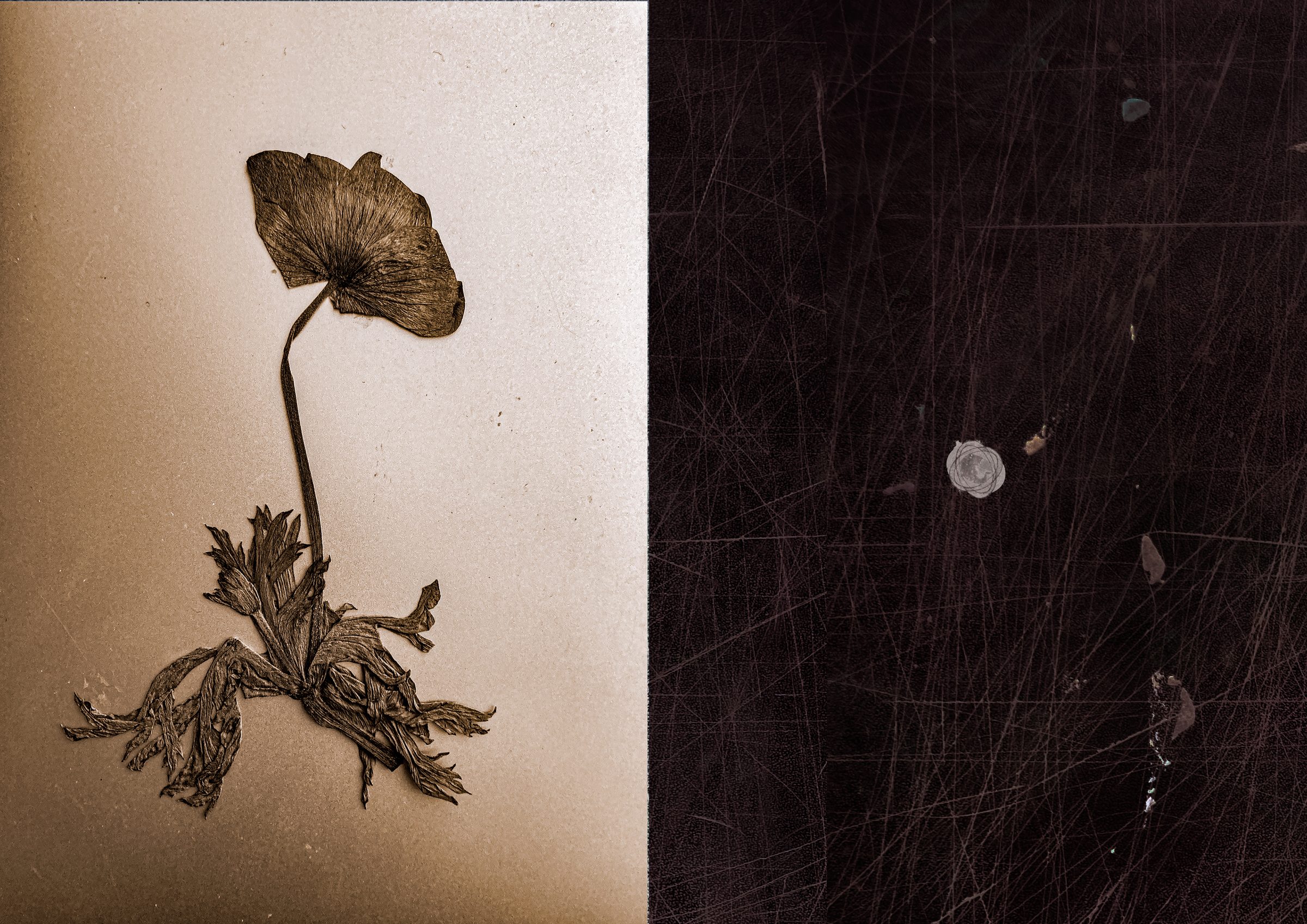
Itzik Rennert, Dead Flower, from the series We’ve Been Kidnapped, 2023–ongoing; archival ink-jet print
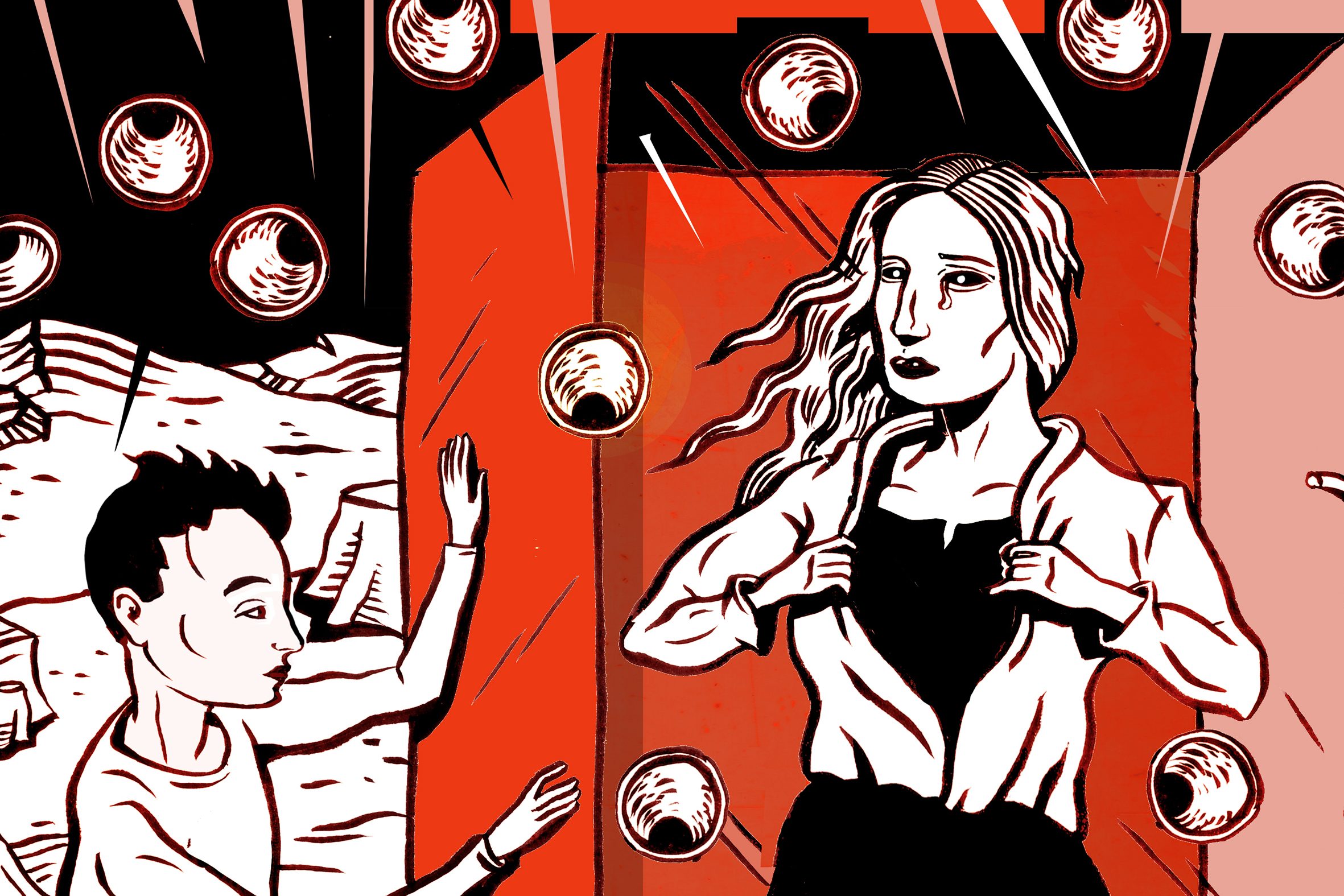
Itzik Rennert, Fear, from the series We’ve Been Kidnapped, 2023–ongoing; archival ink-jet print
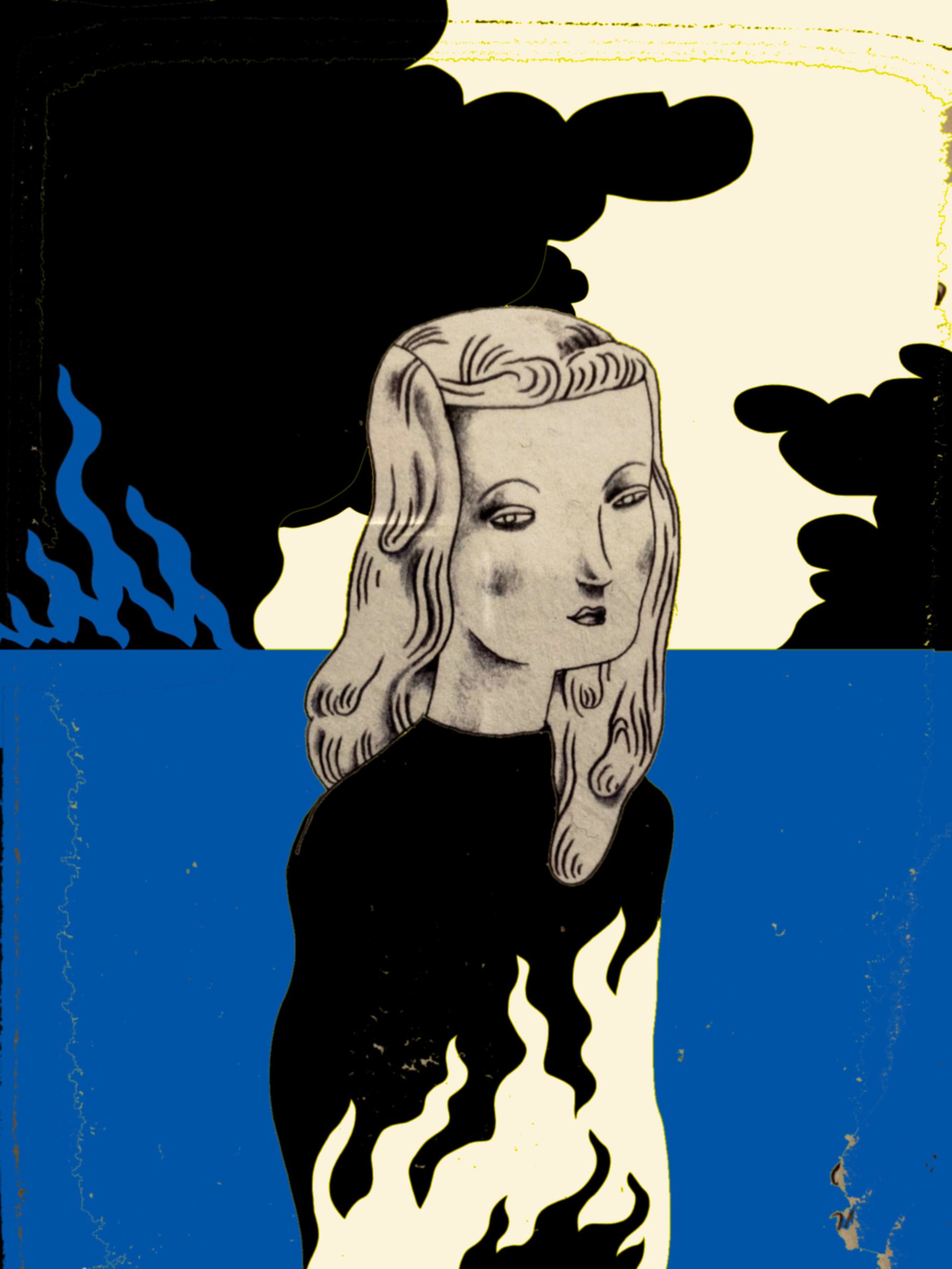
Itzik Rennert, Festival, from the series We’ve Been Kidnapped, 2023–ongoing; archival ink-jet print
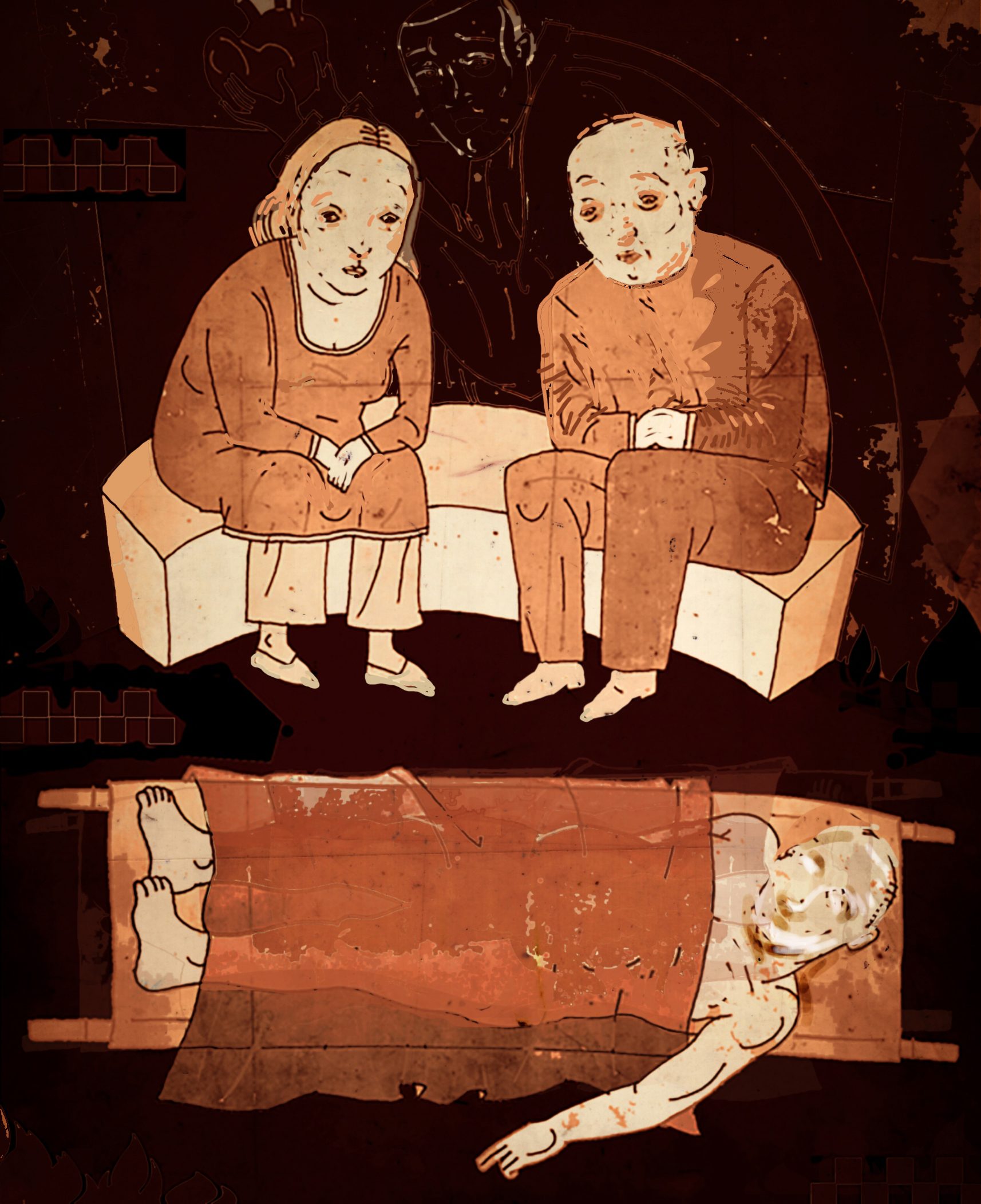
Itzik Rennert, Two Weeks, from the series We’ve Been Kidnapped, 2023–ongoing; archival ink-jet print
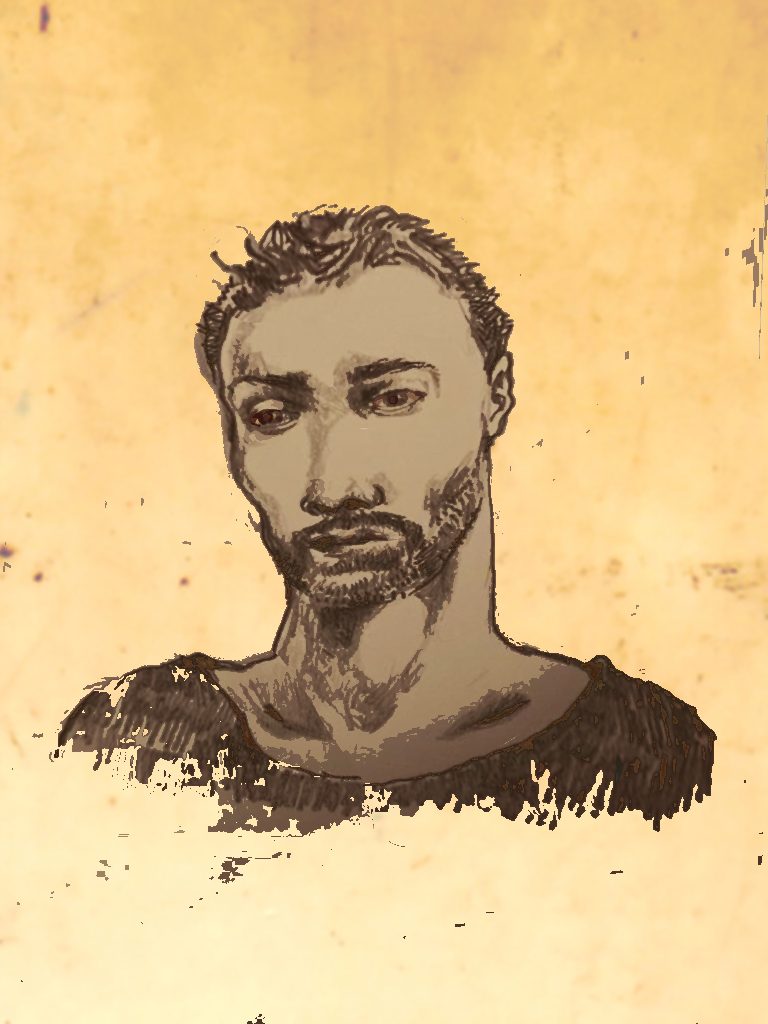
Itzik Rennert, Untitled, from the series We’ve Been Kidnapped, 2023–ongoing; archival ink-jet print
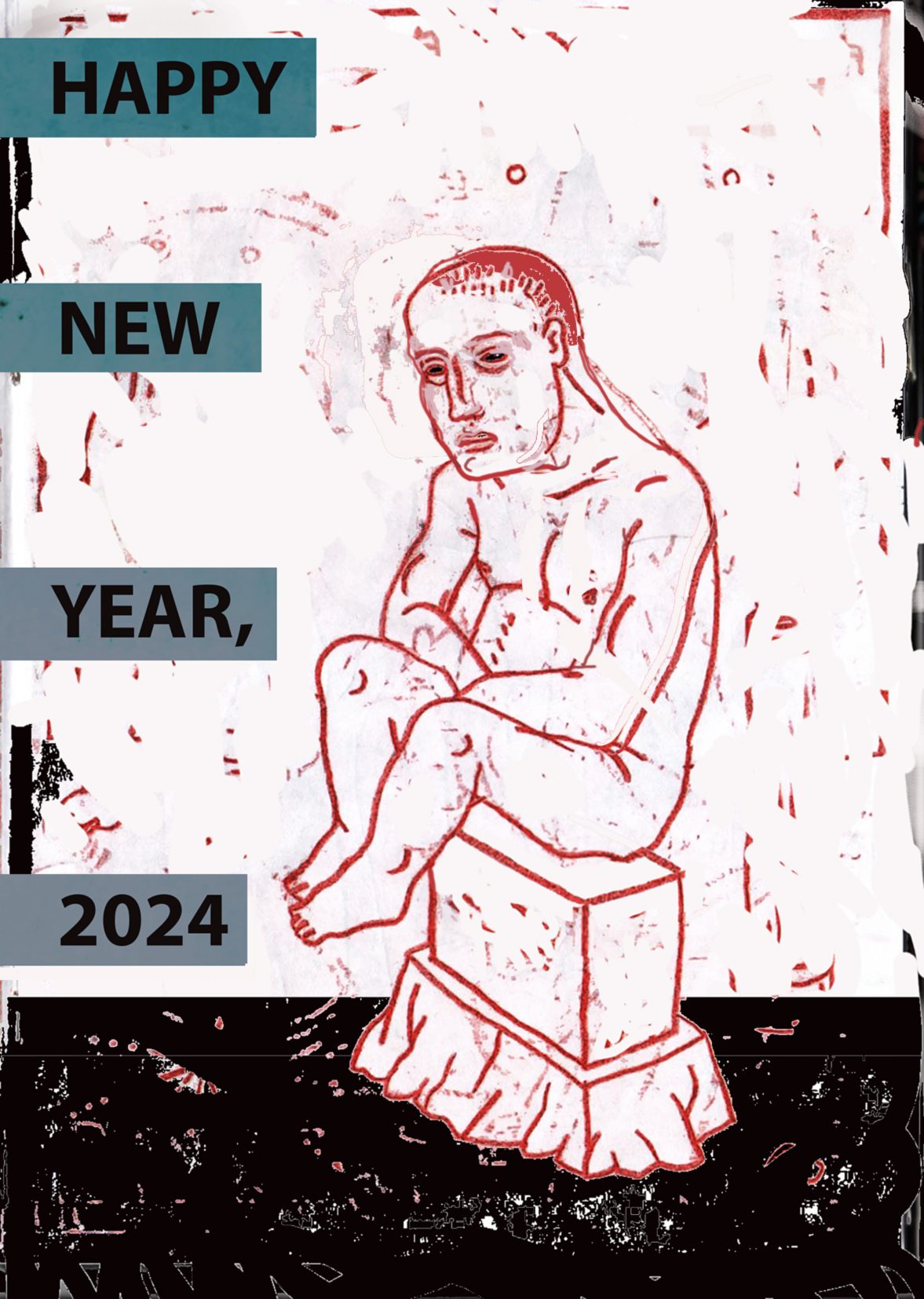
Itzik Rennert, 2024, from the series We’ve Been Kidnapped, 2023–ongoing; archival ink-jet print
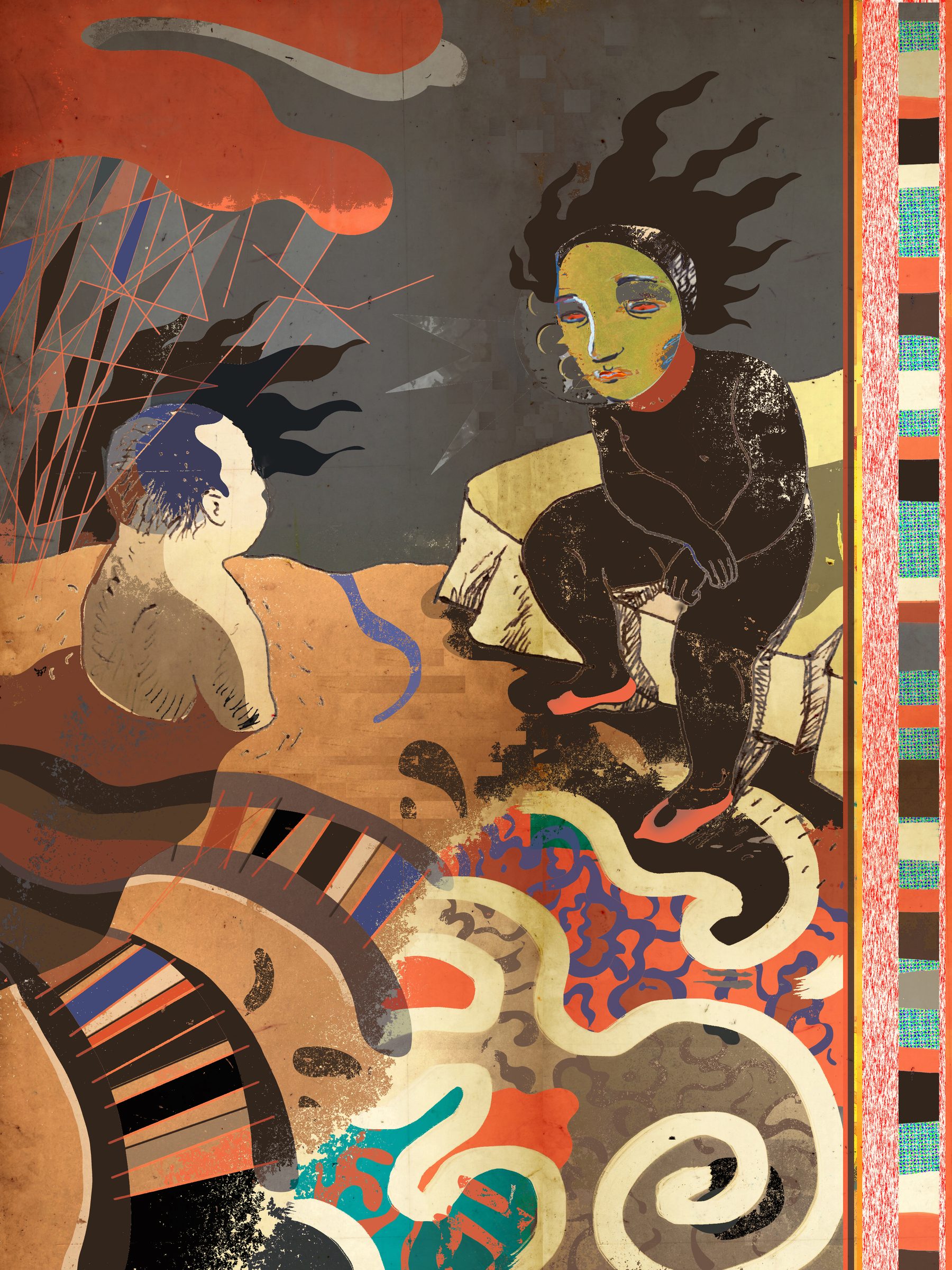
Itzik Rennert, Anxiety, from the series We’ve Been Kidnapped, 2023–ongoing; archival ink-jet print
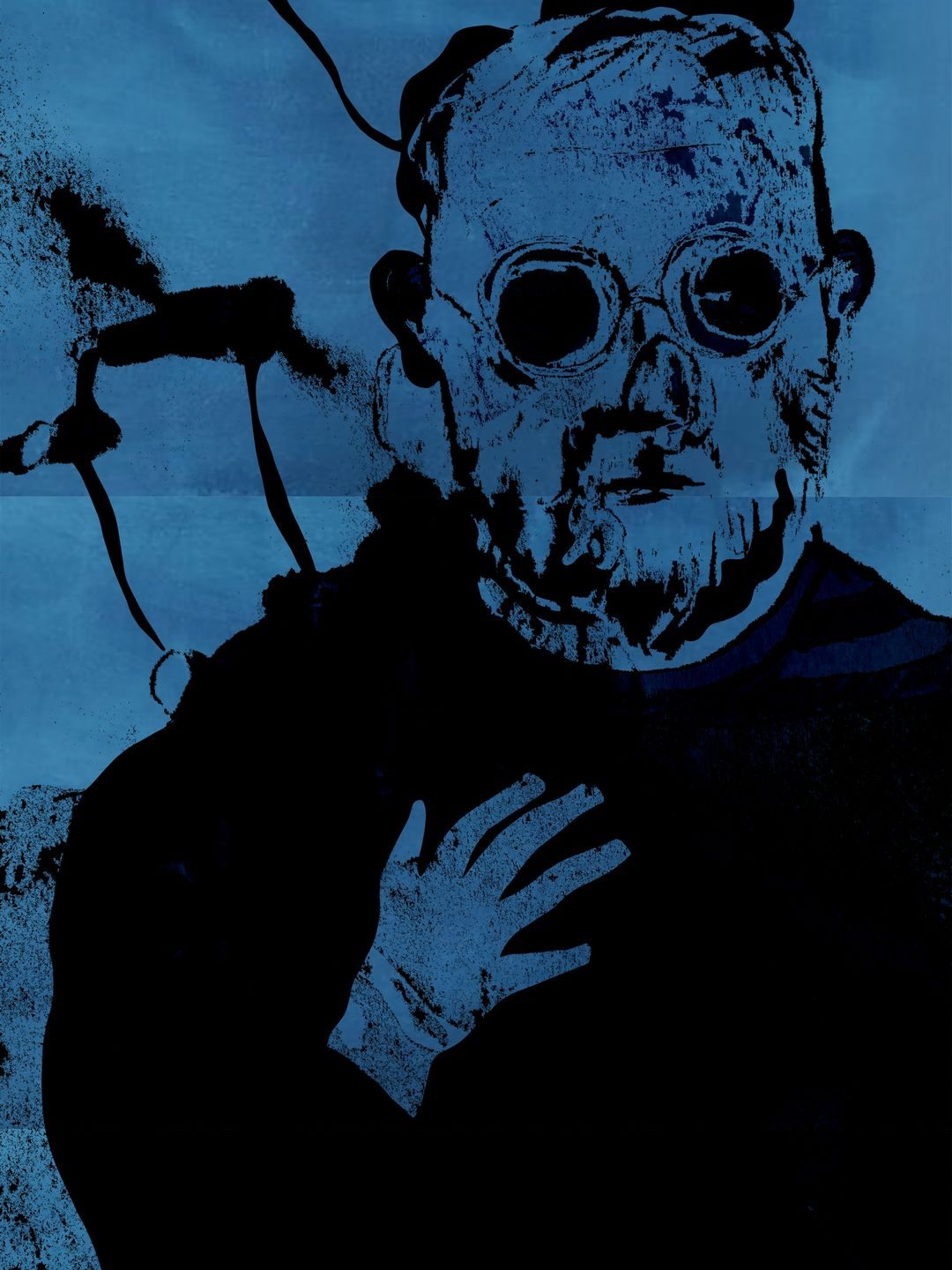
Itzik Rennert, Blue, from the series We’ve Been Kidnapped, 2023–ongoing; archival ink-jet print
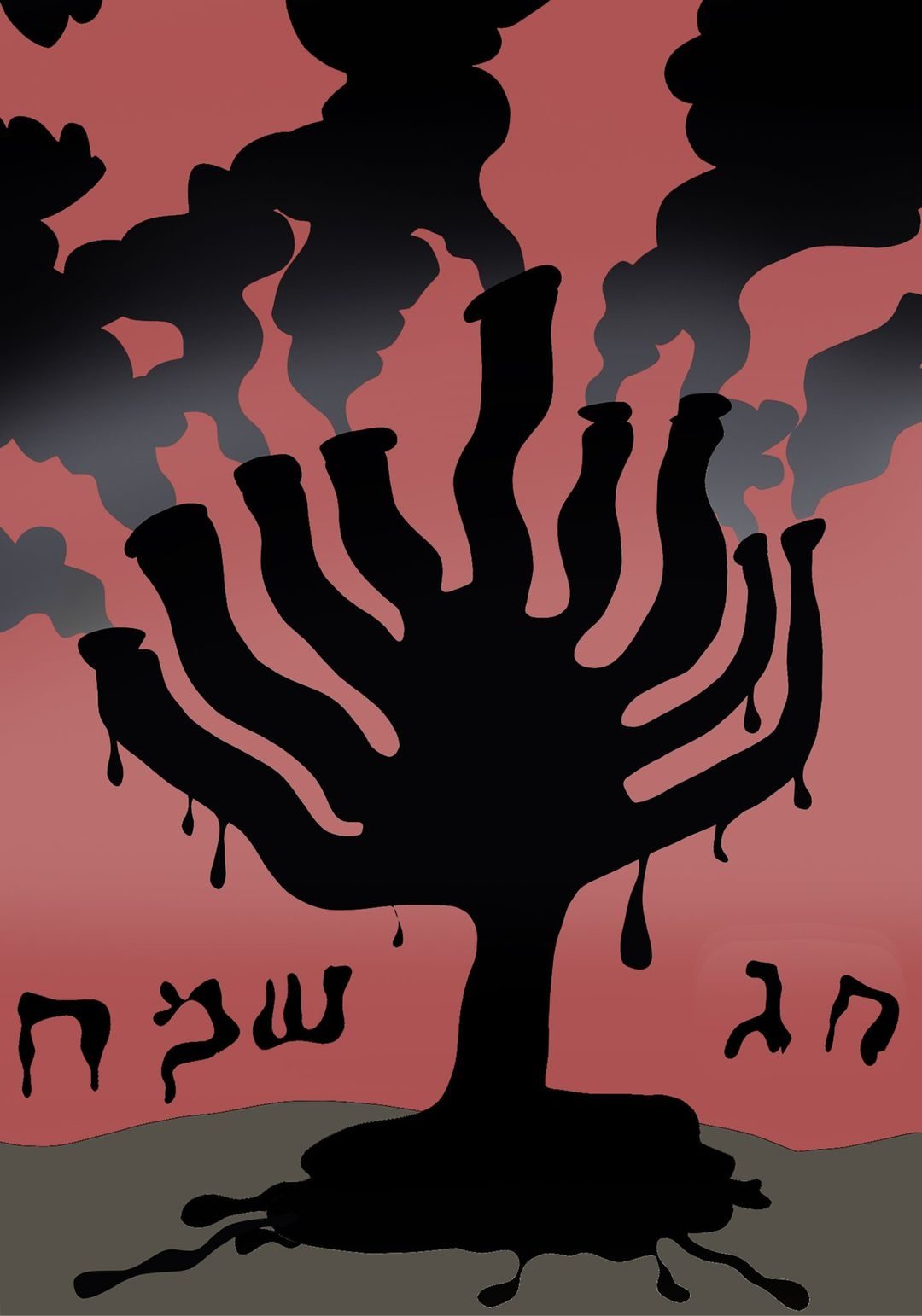
Itzik Rennert, Hag Sameah (Happy Holiday), from the series We’ve Been Kidnapped, 2023–ongoing; archival ink-jet print
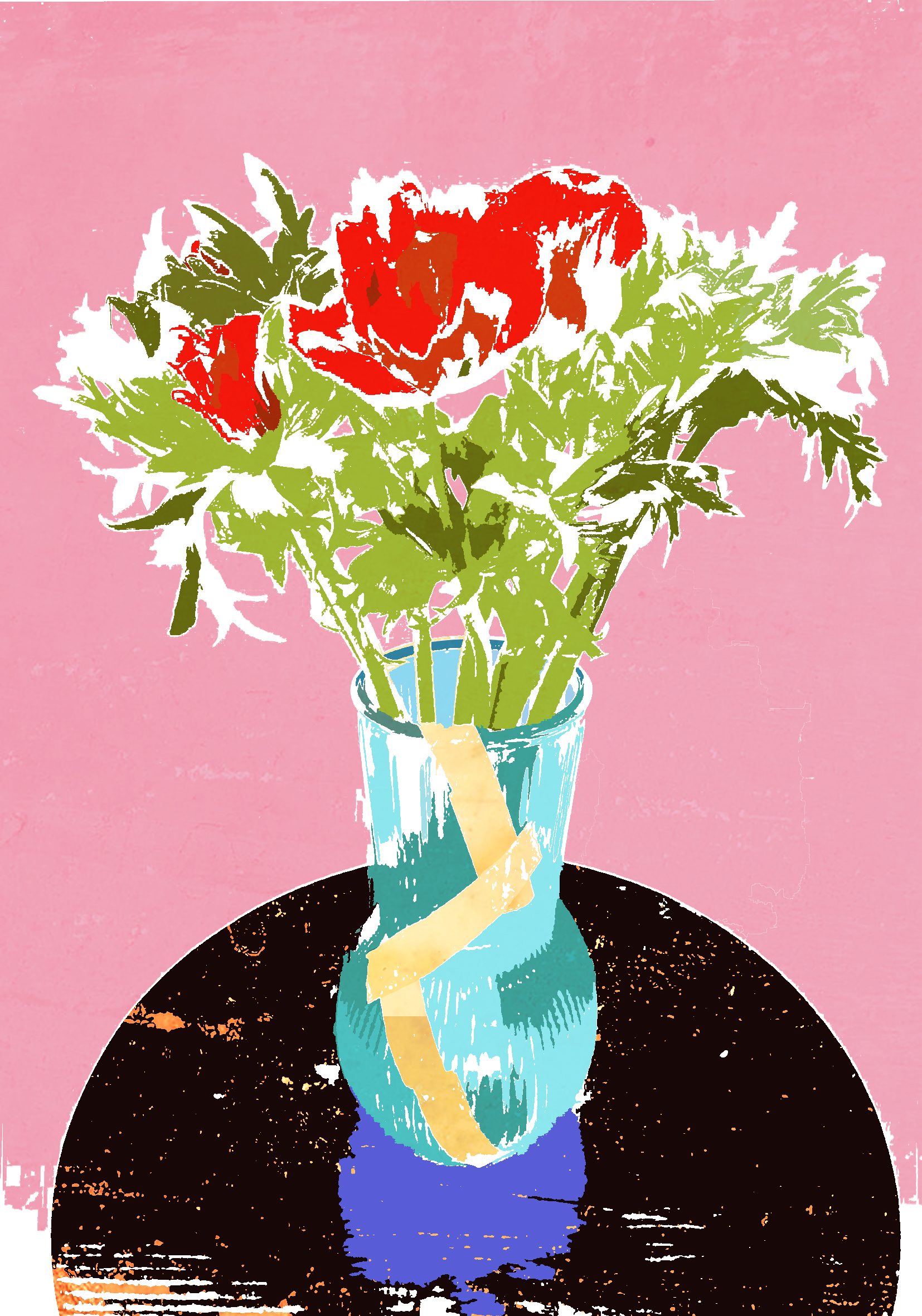
Itzik Rennert, The Day After, from the series We’ve Been Kidnapped, 2023–ongoing; archival ink-jet print
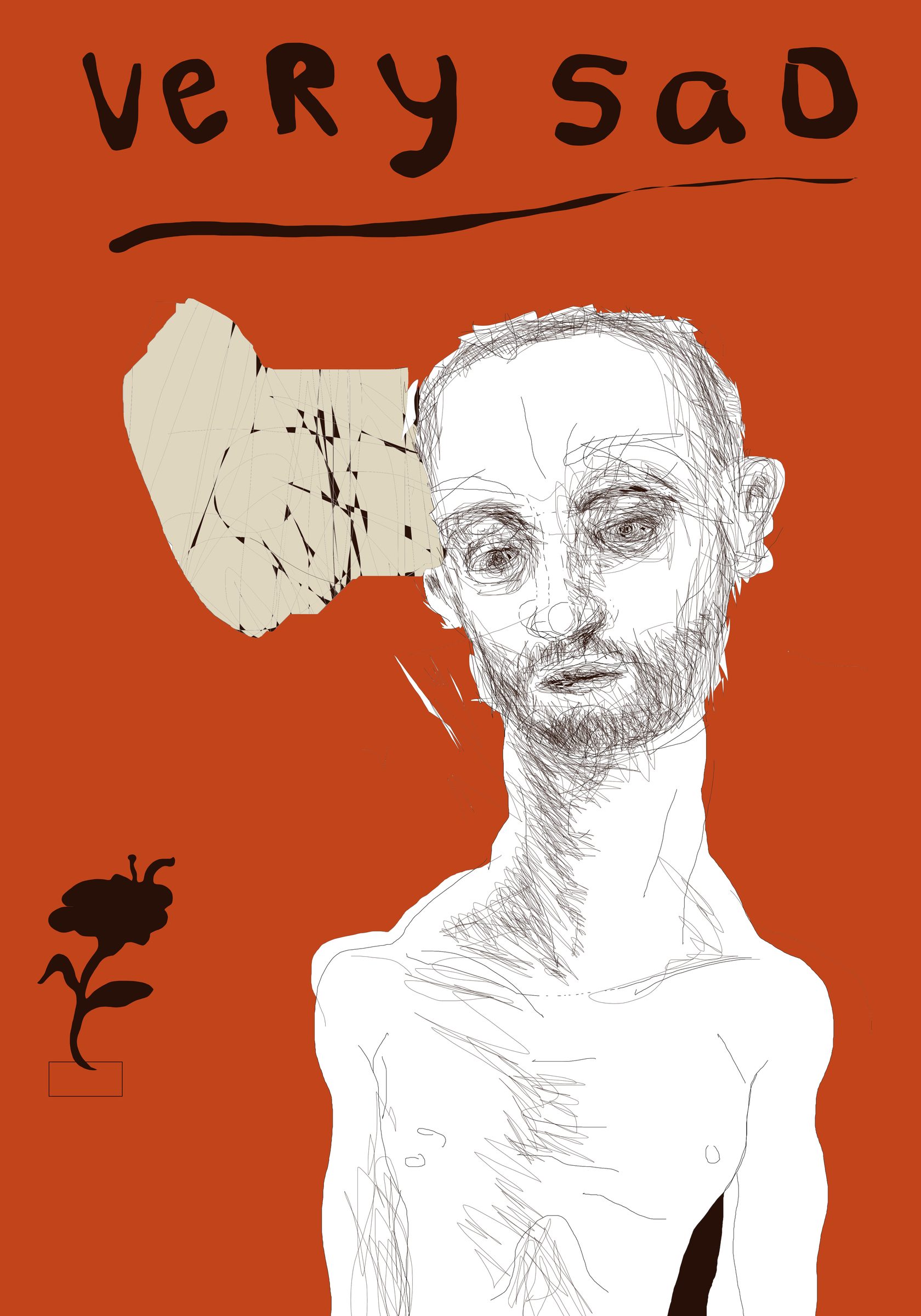
Itzik Rennert, Very Sad, from the series We’ve Been Kidnapped, 2023–ongoing; archival ink-jet print
Rennert has served as a designer in major Israeli media platforms, illustrating and creating comic strips and cartoons for Hadashoth, Yedioth Ahronoth, Maariv, Haaretz, Ha’Ir, Globes, and others. He was a member of the internationally renowned Actus comics collective, served as an art director of leading advertising agencies in Israel, and illustrated well-regarded children’s books, including The Man with the Story in His Head by Yossi Banai and Allergy by Yehonatan Geffen. His work has been shown in numerous exhibitions in Israel and around the world.
Rennert is a senior lecturer and ex-chair of the Department of Visual Communication in Shenkar College of Engineering, Design and Art in Ramat Gan. Previously he headed the Illustration Program in the Department of Visual Communication of Bezalel Academy of Arts and Design in Jerusalem. He is a graduate of the Bezalel Academy and Istituto Europeo di Design in Milan, Italy. Rennert lives and works in Tel Aviv.
Rennert’s illustrations often begin as hand drawings on paper that are then elaborated through digital manipulation. The ongoing series presented here are digital illustrations produced as archival ink-jet prints. Several images were created on request from private people and organizations acting on behalf of the kidnapped Israelis. Many images were based on earlier work, a process that Rennert attributes partially to the debilitating effect of the trauma and the shock. While feeling a need to react, he also feels precluded from coming up with something “new”. In part though, this reworking also allowed reassessment of earlier material. Both images titled HAMAS IS ISIS# (And Children Too) were based on works produced for an Israeli civil rights group that advocated for Palestinian children imprisoned in Israeli jails. “Kidnapped or imprisoned, children are children,” says Rennert. At the same time new images - the mourning couple, fragile and uncertain portraits, a mended vase with a distressed blossom - hold a timid promise of repair, while the few stringent caricatures give shape to the widespread disdain and anger at the current Israeli political and military leadership.
Osi (Osnat) Wald
(b. 1978) Animation artist and teacher
Osi Wald, short animations, October 2023 – April 2024; digital animation
Wald specializes in experimental and site-specific animation and alternative collaborative processes, combining dance and animation on stage and screen. Her award-winning animated documentary Holy Holocaust (2021), co-directed with Noa Berman-Hertzberg, was acquired by The New Yorker in 2022. Wald’s work took the form of an animated installation screened on the beach in Bat Yam (Joints 2018); developed in response to the catalogue archive of the Israel Museum, Jerusalem (Reorganization 2017); presented as a dance piece incorporating a magical animation box (Year of the Hare 2012), and many more. Wald was a key member of the animation team of the internationally recognized director Ari Folman and worked on his films Waltz with Bashir (2009) and The Congress (2013). She worked as an animator on numerous Israeli TV series.
Wald is the current artistic director of A Face. A Day. A Memory, an artistic animation initiative of Beit Avi Chai, Jerusalem, dedicated to the memory of fallen IDF soldiers and those who lost their lives in terrorist attacks. She is a lecturer at the Department of Screen-Based Arts, Bezalel Academy of Arts and Design in Jerusalem. She serves as a mentor, artistic consultant and lecturer in animation funds and hubs. She is a graduate of Bezalel Academy of Arts and Design.
The 2D digital animations presented here were created at different times after the October 7 attack. They are very short personal impressions and were made to be featured and shared on social media immediately after each of them was completed. Simple and sketchy, the animations allow a glimpse into the emotional turmoil and change that Wald experienced. Featured in chronological order of their appearance the works are accompanied by the commentary provided by Wald on her Facebook page. Three animations, Days, The Road to Somewhere Far and Kfir Bibas at the Age of 9, were commissioned as part of different social projects.